
These therapy progress note templates include the six common note formats and ten more forms for particular sessions and records, such as an intake, a group session, a crisis, a treatment plan review and a discharge. All 16 are fillable PDFs with a separate field for each writing line. What you type lands on the printed line, and you press Tab to move to the next one. Each PDF ends with a filled example for a fictional client and a page on how to write that note, with a checklist to go through before you sign.
The templates are documentation aids, not legal, billing or clinical advice. Where your payer, state, licensing board or agency sets a rule for your notes, follow their rule over anything here. Store completed notes securely, in line with HIPAA or your local privacy law.
Therapy Progress Note Templates
Every template is US Letter and is a fillable PDF. You can type a note on screen and save it, or print the blank pages and write by hand on the same lines. Each PDF includes the following:
- The blank note, one to four pages, with a header for the client’s name and ID or date of birth, the date of service, start and end times, total minutes, the service and diagnosis codes, session type, place of service and others present.
- A continuation page in most of them, for a note that needs more room.
- Risk screening for suicidal ideation, homicidal ideation and self-harm, with the risk level, the safety plan and protective factors. The shorter notes have a compact version of it.
- A signature row for your signature and credentials, the date and time you signed, and a supervisor’s signature for associates and interns.
- Useful wording on the how-to-write page, along with a table on that note’s trickiest part.
The client’s name, ID and date of service repeat on every later page, and every page has a footer marking it as confidential.
SOAP is the format a doctor’s office is most likely to recognize, which helps when you work in integrated or medical care and share notes with medical providers. With SOAP, you can keep the client’s own account, starting with their chief concern in their words, apart from what you observed and measured. The mental status check takes a tick for each area within normal limits and a few words on the rest, and in the scores table you can see at a glance whether today’s results have moved since the last session. It’s a two-page note.
SOAP Progress Note

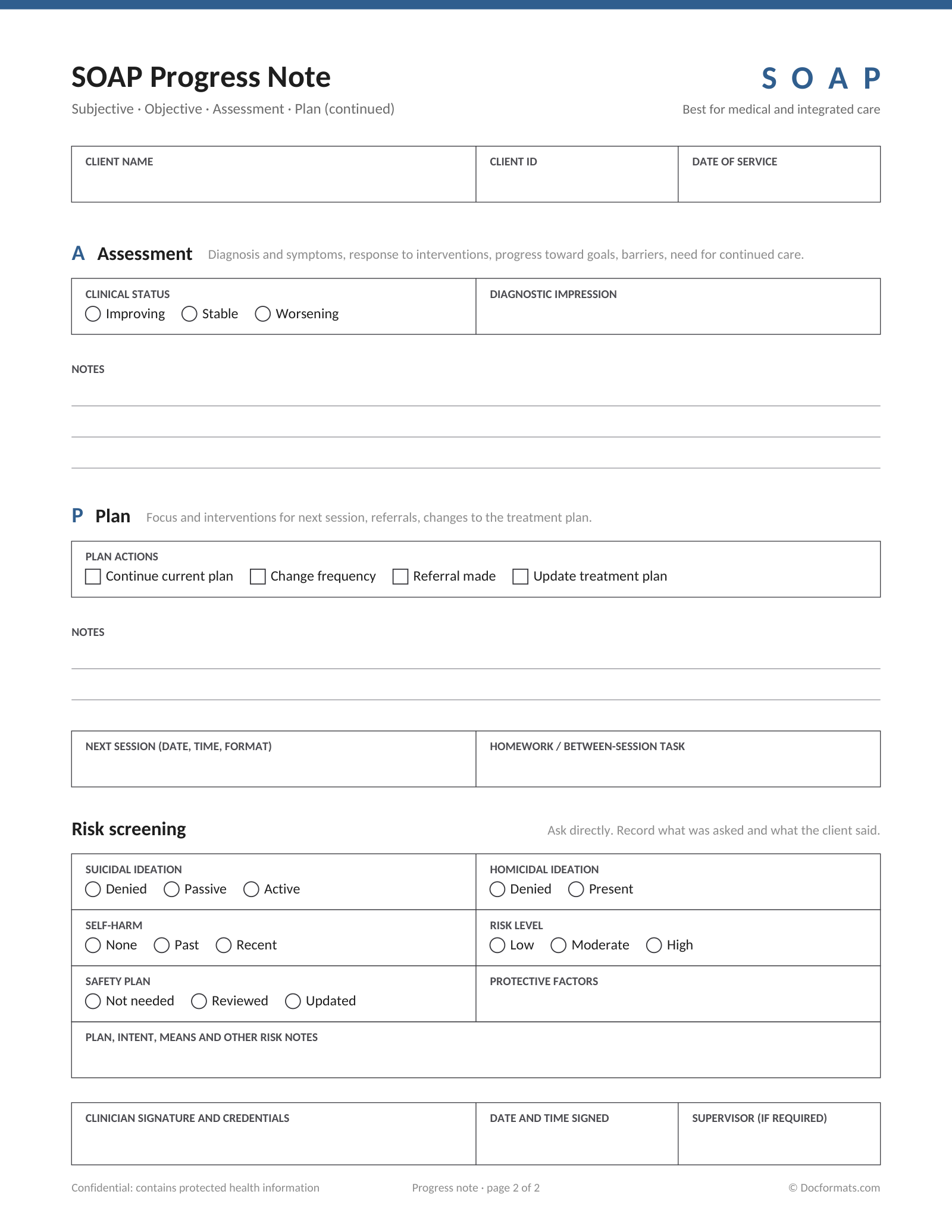


SOAP Progress Note
For counselors seeing clients week to week, the DAP note is a one-page note for routine sessions. You write what the client reported and what you observed together under Data, which keeps a complete note short. Assessment says what the session means for the client’s goals, and the Plan, the next session, homework and a short risk check complete the page.
DAP Progress Note


DAP Progress Note
In behavioral health and substance use work, progress shows in behavior you can count from week to week, and the BIRP note centers on that behavior. On this note, each target behavior has this week’s figure, last week’s and the change. The interventions list includes motivational interviewing, relapse prevention and DBT skills, among others, and the risk section includes use since the last session, craving from 0 to 10 and the date of last use.
BIRP Progress Note

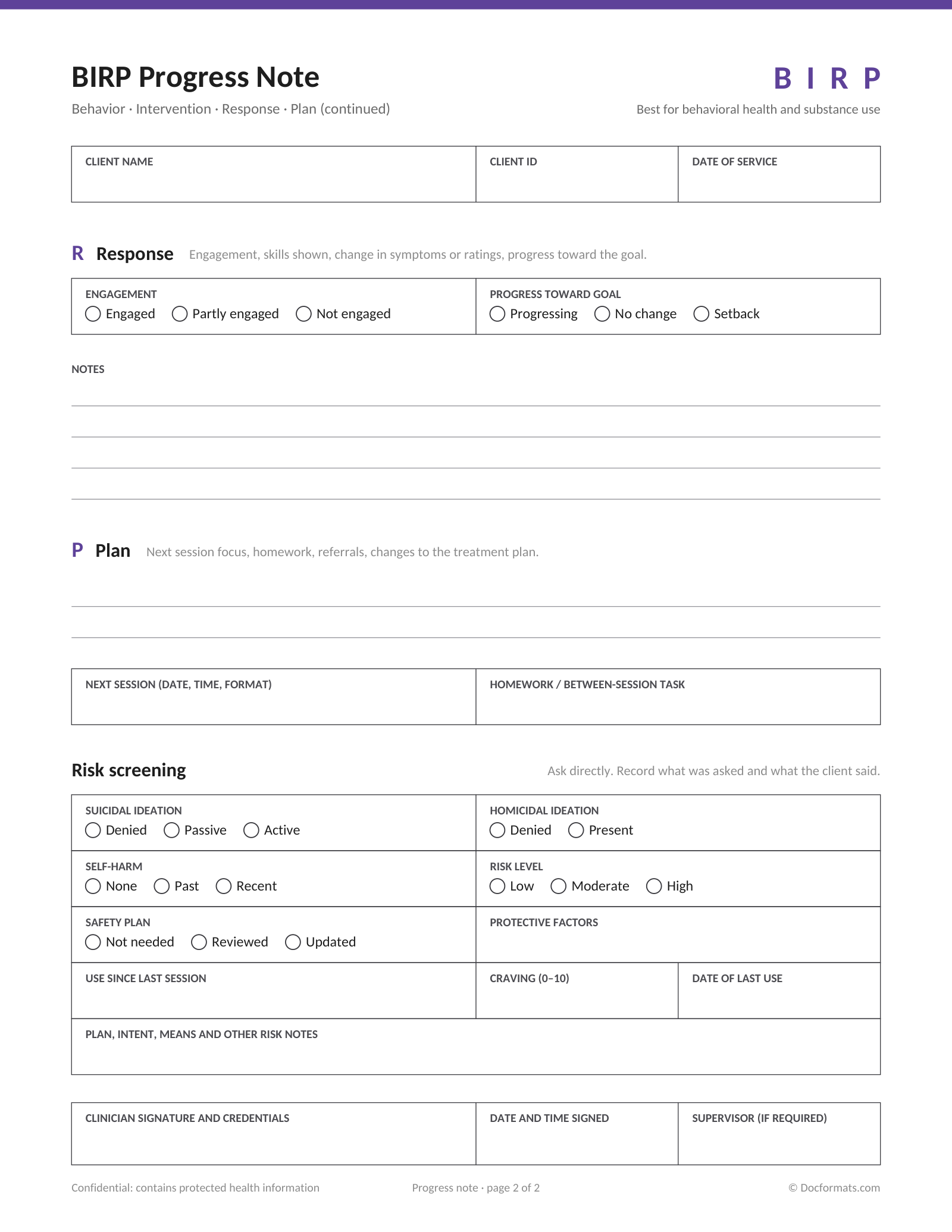


BIRP Progress Note
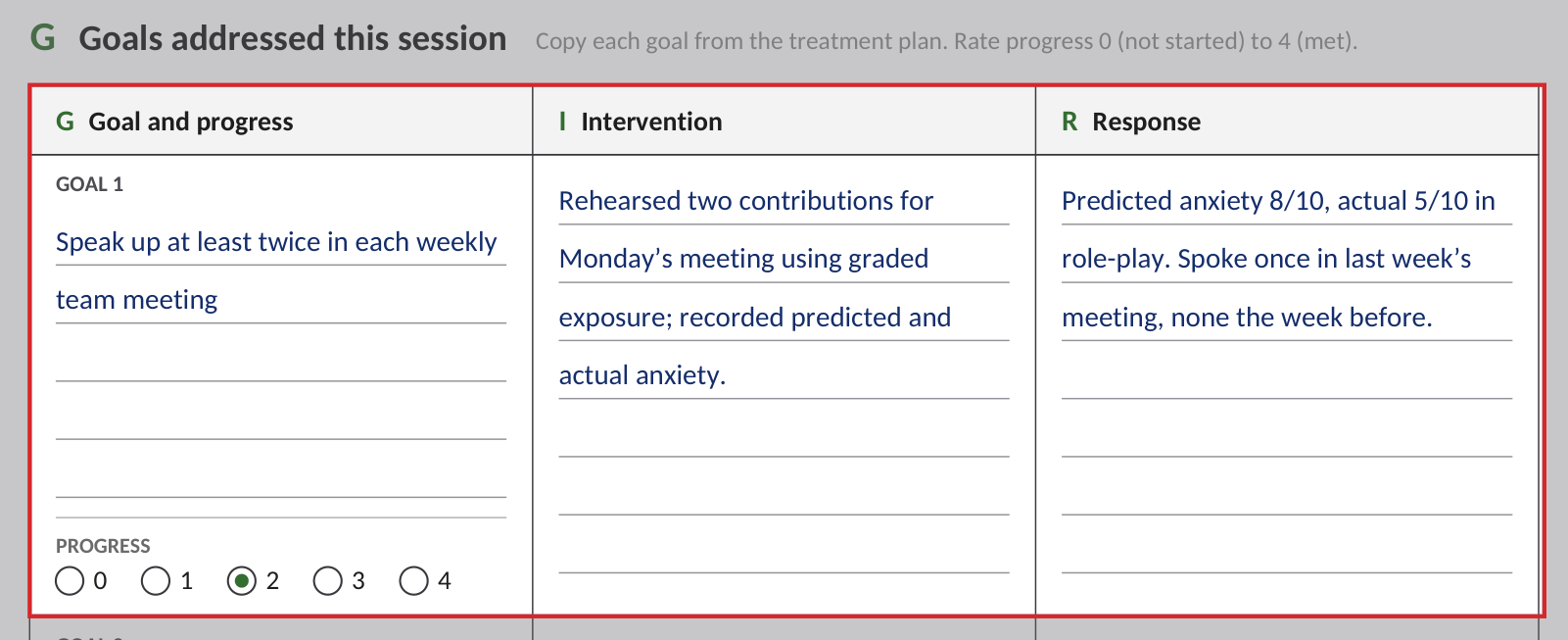
GIRP suits clinicians whose payer or agency wants every session linked to a treatment-plan goal. Each goal from the plan has its own row, with the intervention you used for it, the client’s response and a progress rating from 0, not started, to 4, met. There’s room as well for changes to the treatment plan, the next step for each goal and anything getting in the way of progress. Writing down what’s in the way explains to anyone reviewing the note why a goal hasn’t moved.
GIRP Progress Note


GIRP Progress Note
Case managers and nursing staff who have many short contacts with a client, over a shift or a week, can keep one running record on the PIE flow sheet. It includes a numbered problem list with the date each problem was identified and its status, active, improving or resolved. Each contact after that gets a dated row with the problem number, the intervention and the evaluation, initialed by whoever wrote it, and the signature log has each person’s name and credentials.
PIE Progress Note

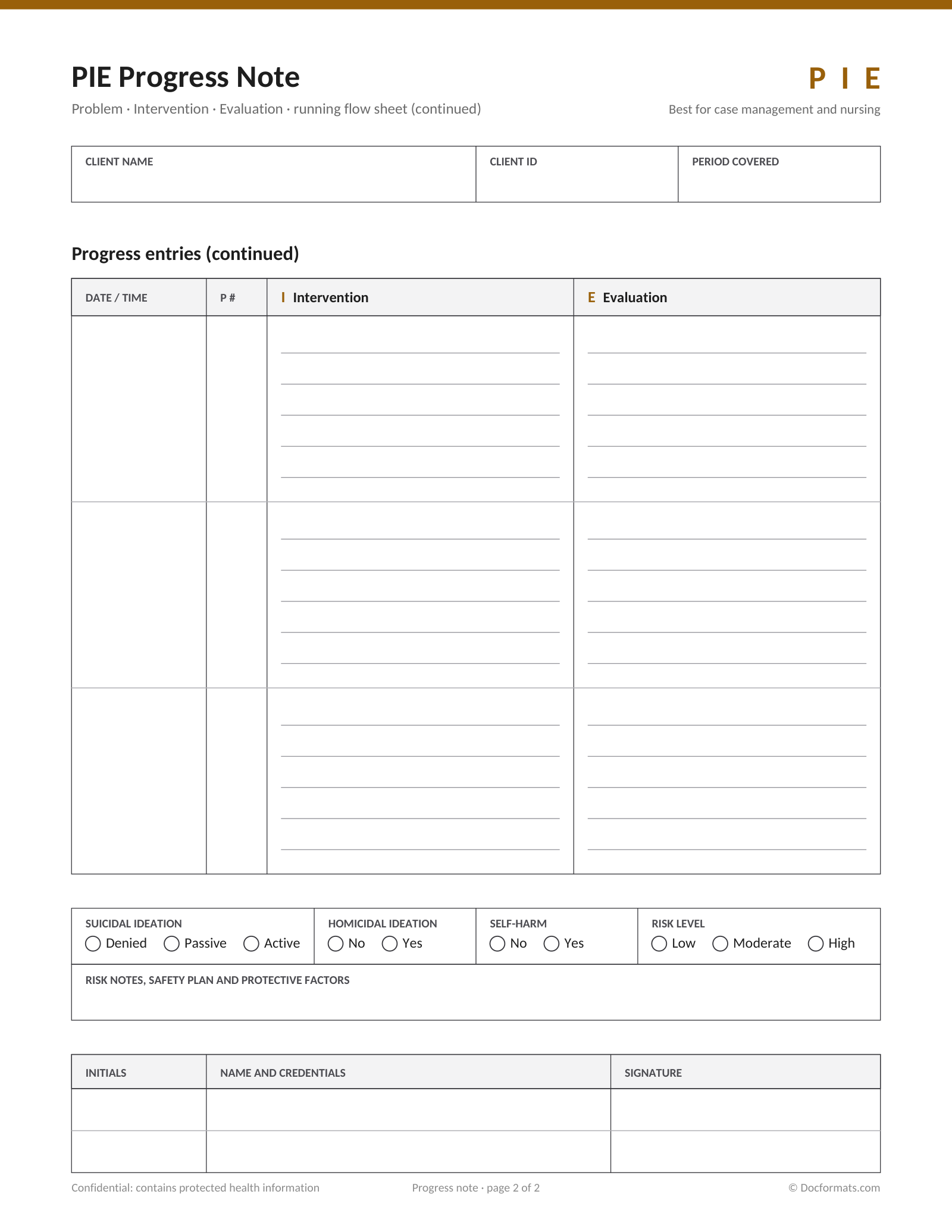


PIE Progress Note
The SIRP note is for a crisis contact outside a scheduled session, in person, by phone or video, or with a mobile team. It includes the reasons for the contact, a timeline of key times, the client’s state when the contact ended, a safety plan written with the client in their own words, the disposition and who you notified or consulted. With the times and names recorded, anyone checking the contact later can see how quickly you acted and who you involved.
SIRP Progress Note


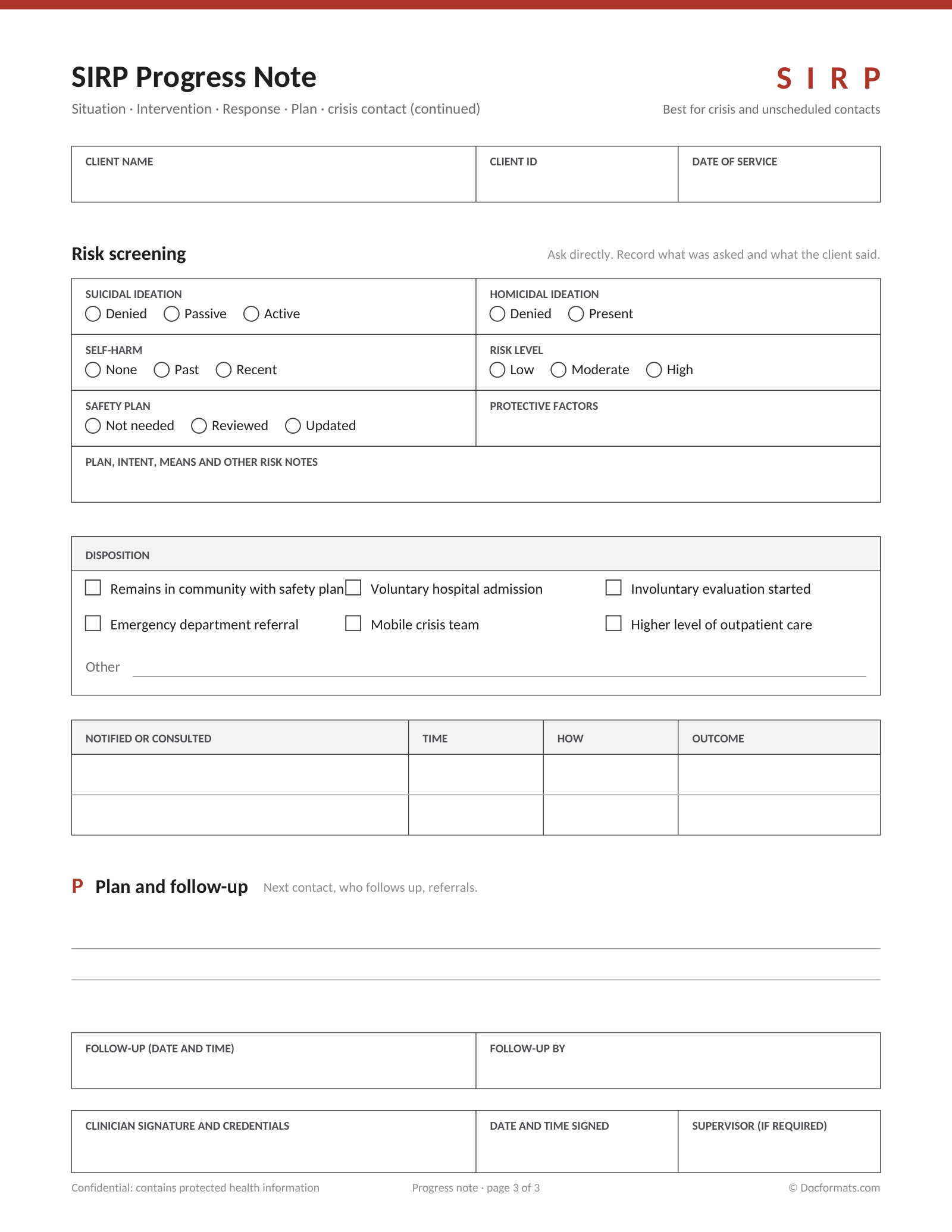
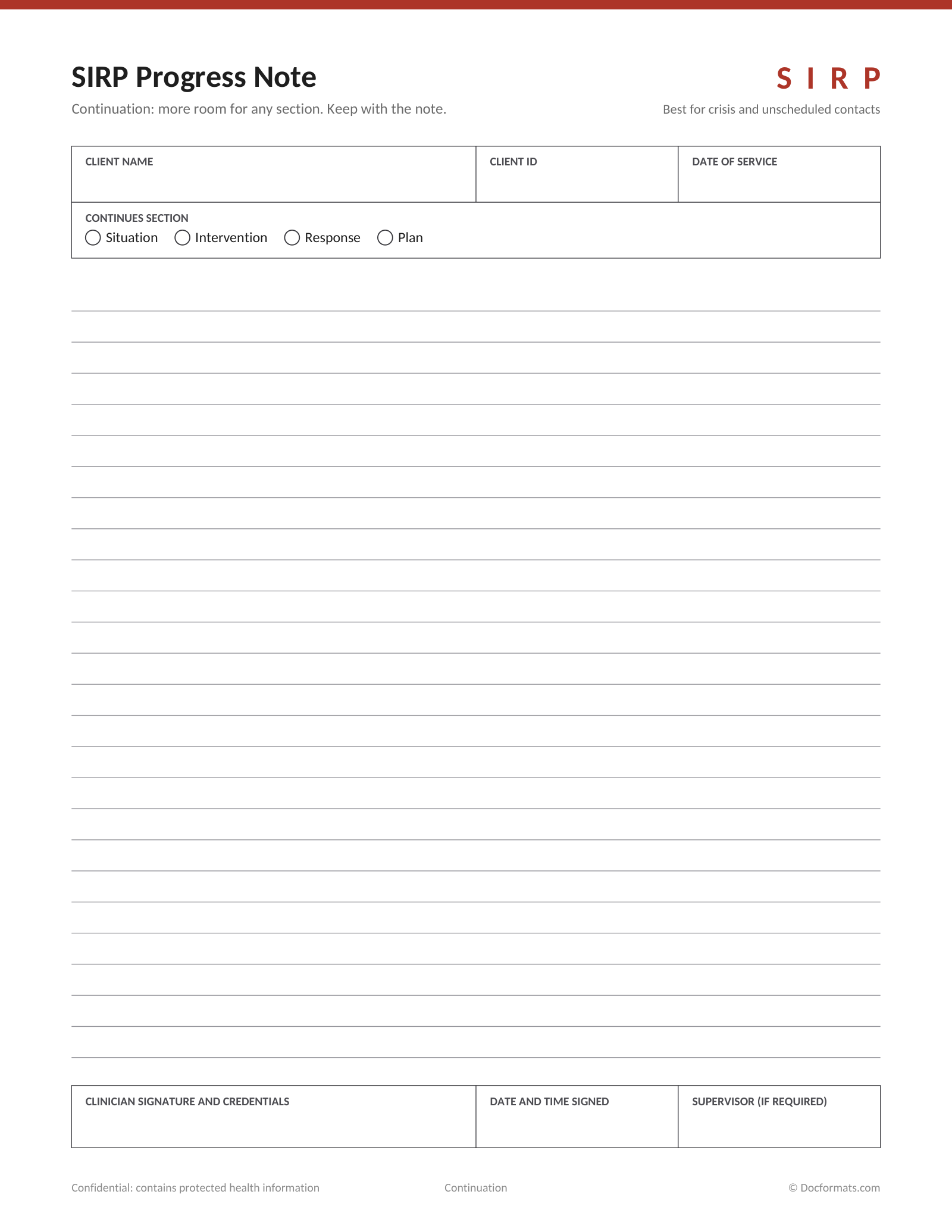
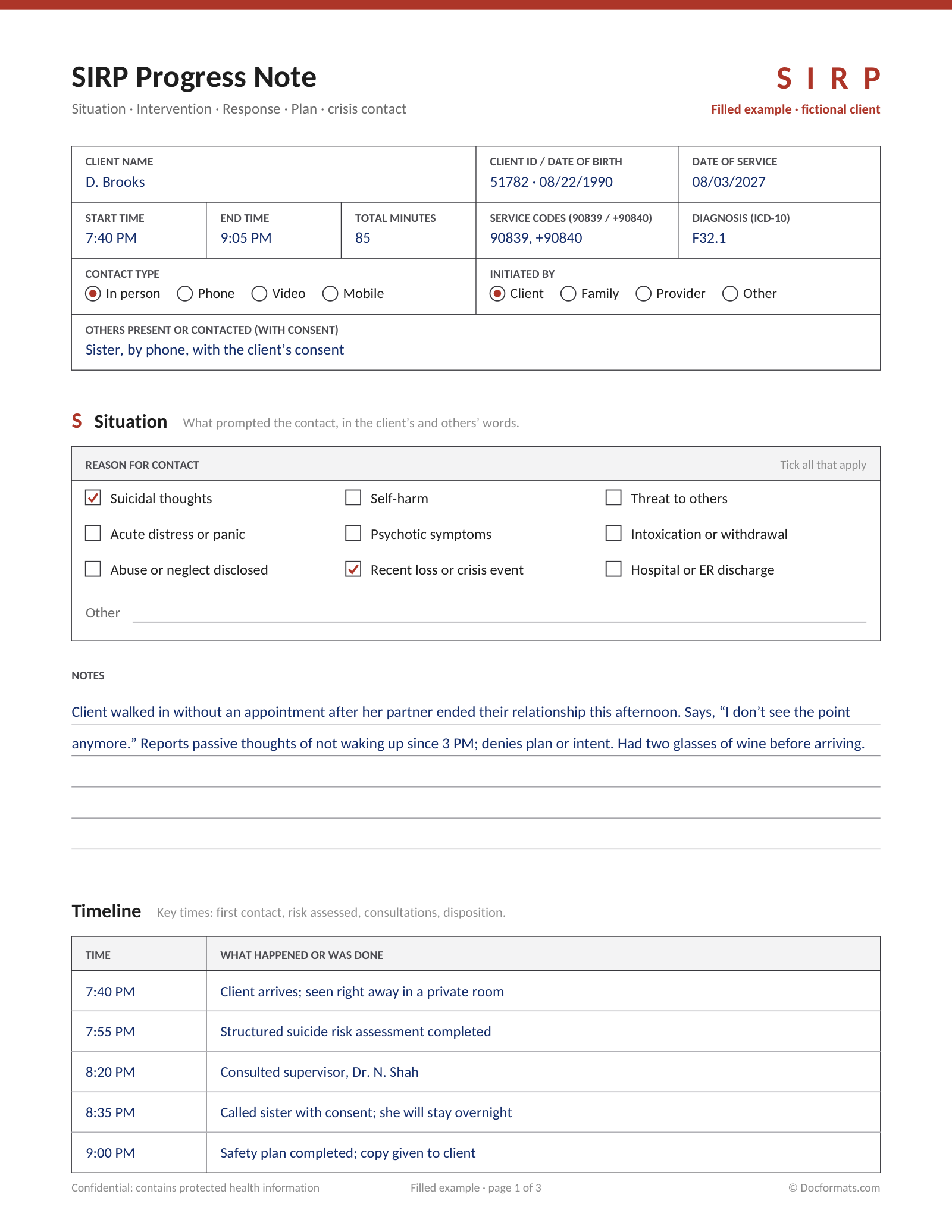
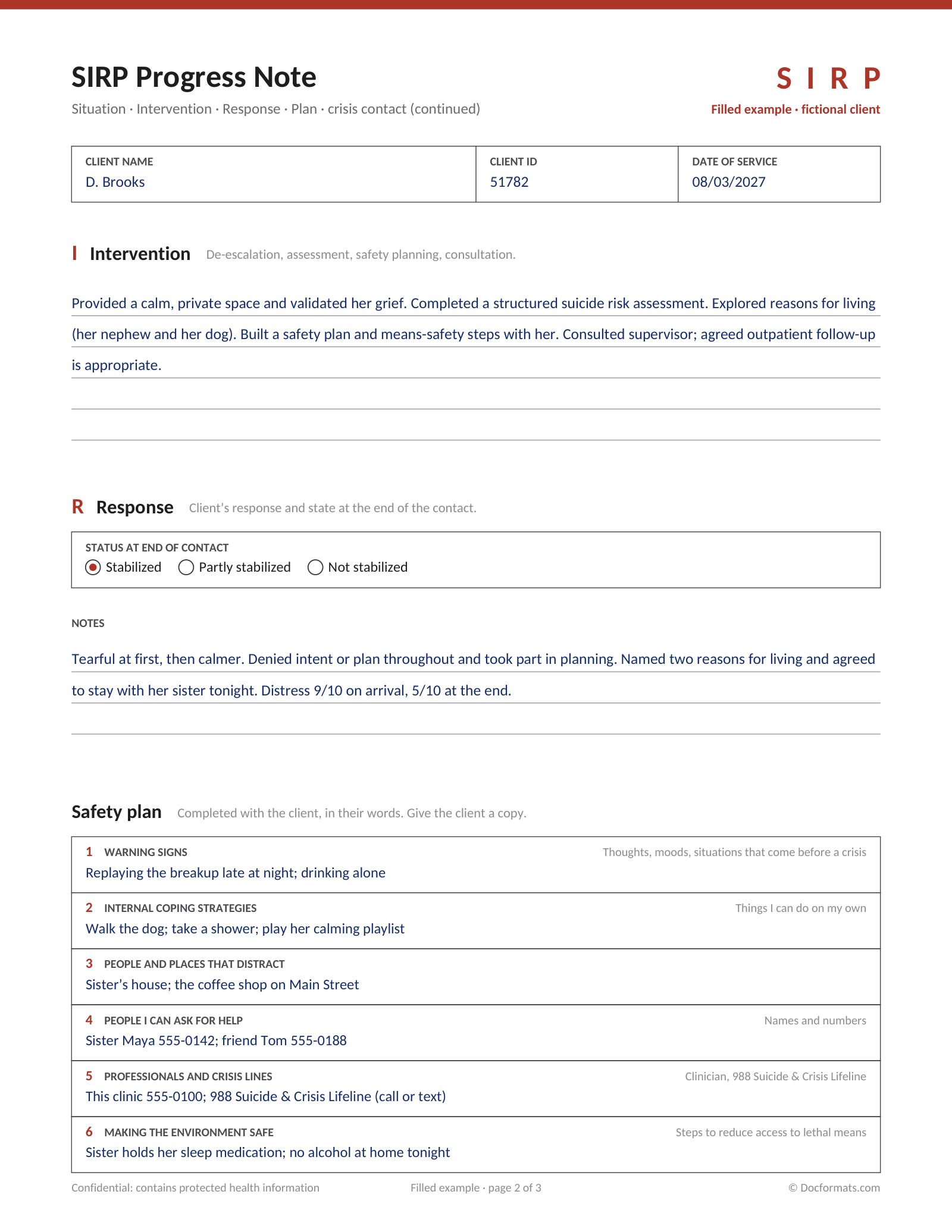
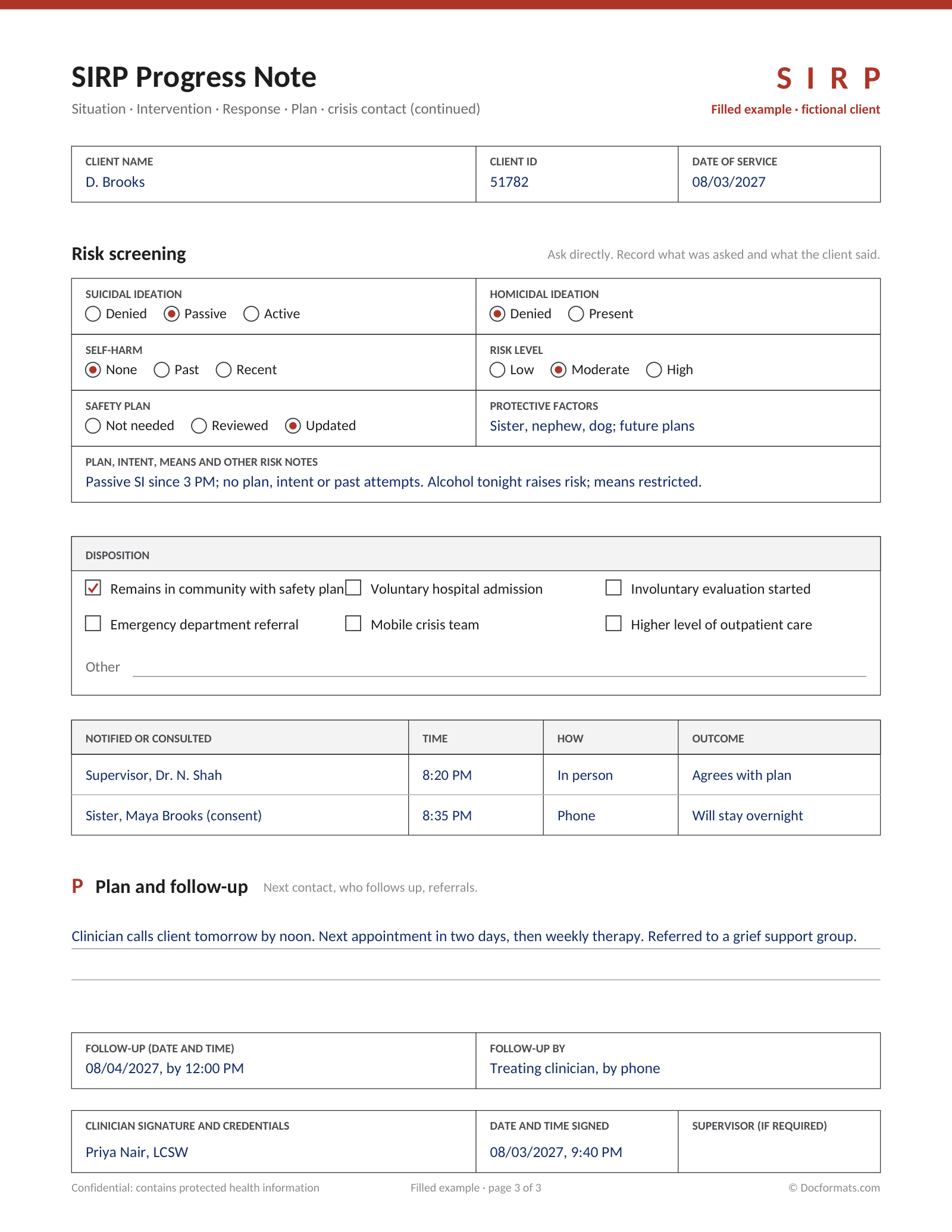
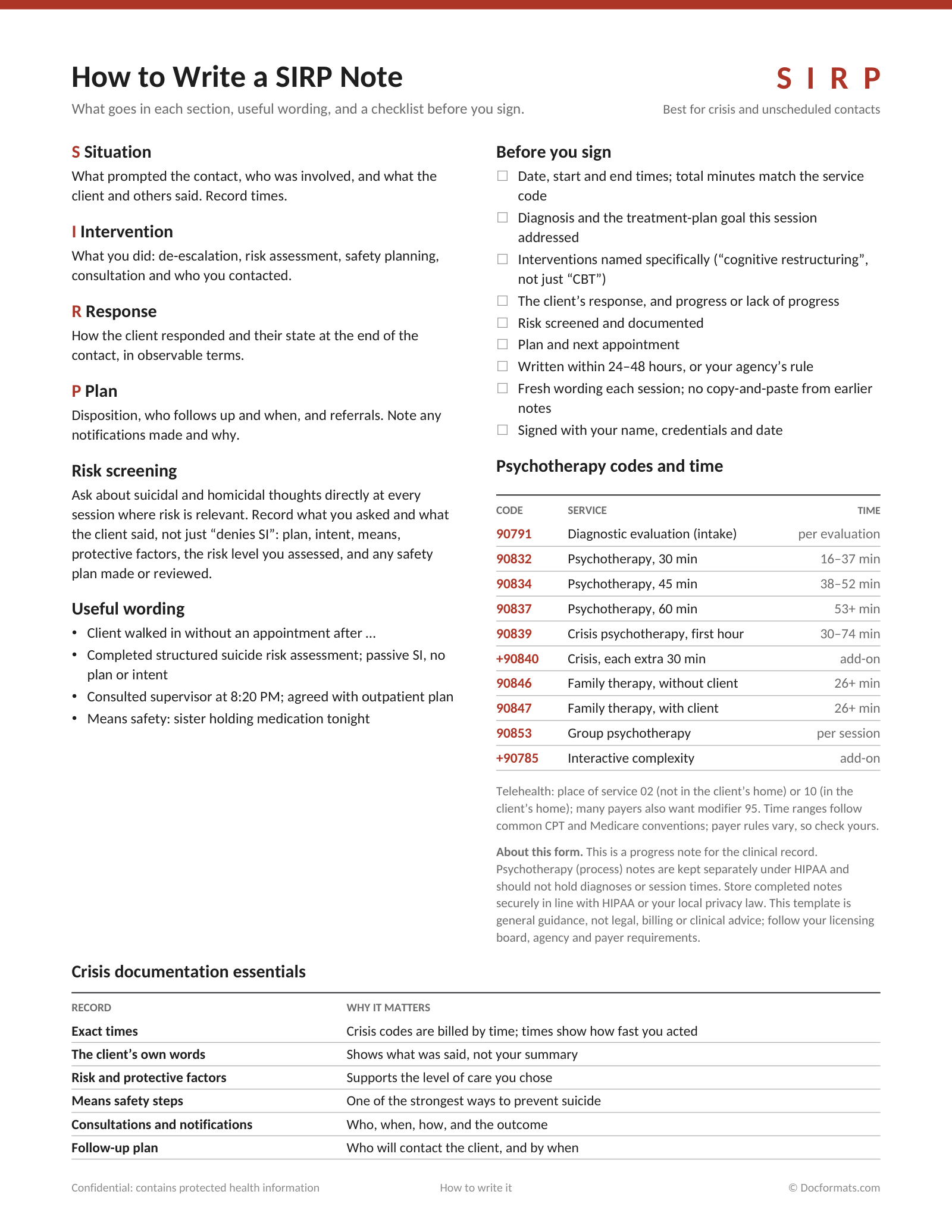
SIRP Progress Note
The intake assessment note is meant for a client’s first session, billed as a diagnostic evaluation (CPT 90791), when you gather their history before treatment starts. In one note, you can work through the presenting problem and symptoms, mental health, medical and substance use history, family, social and cultural background and the client’s goals, then mental status, risk and your diagnostic impression. Checks for informed consent, the privacy notice, telehealth consent and any release of information are on it too, as these need to be complete before treatment starts.
Intake Assessment Note


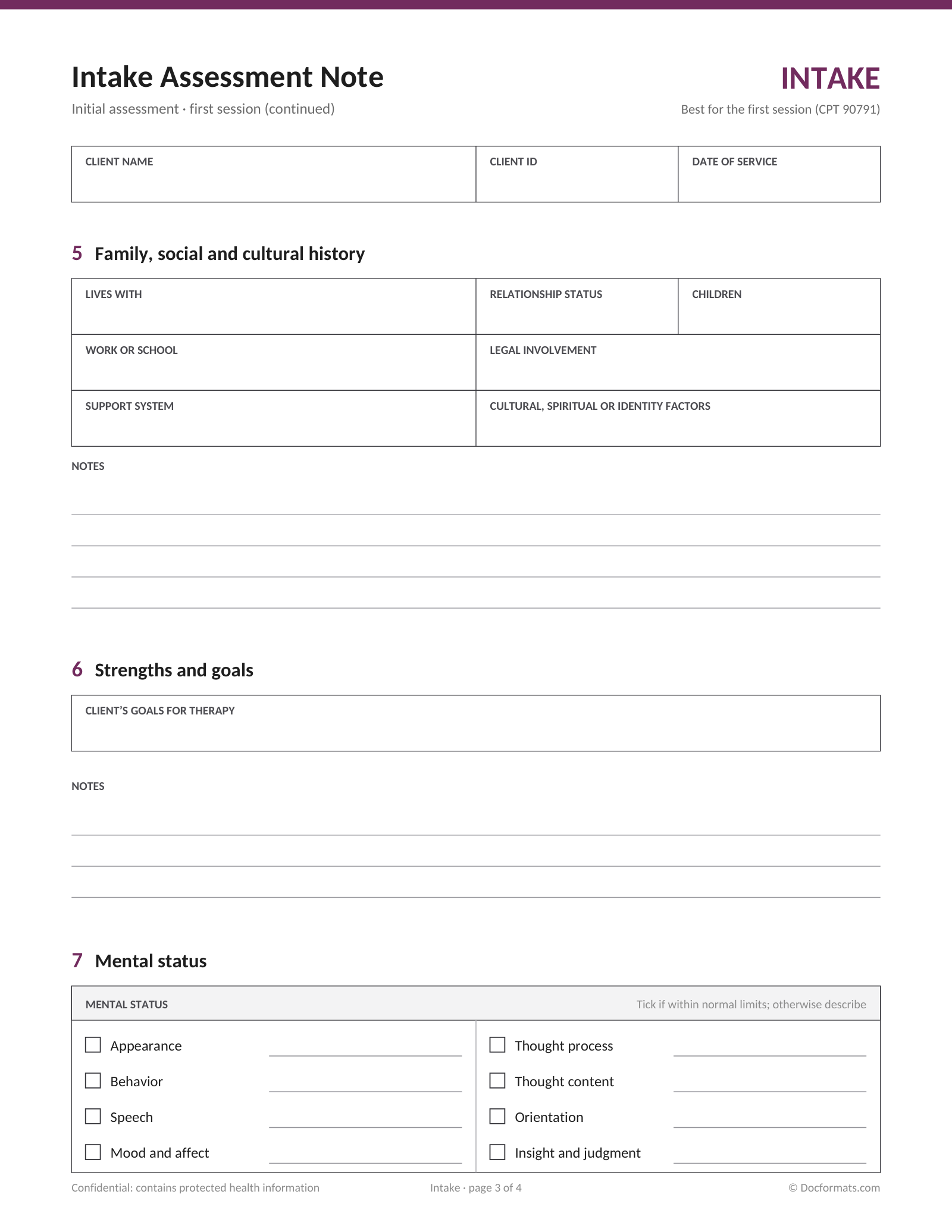
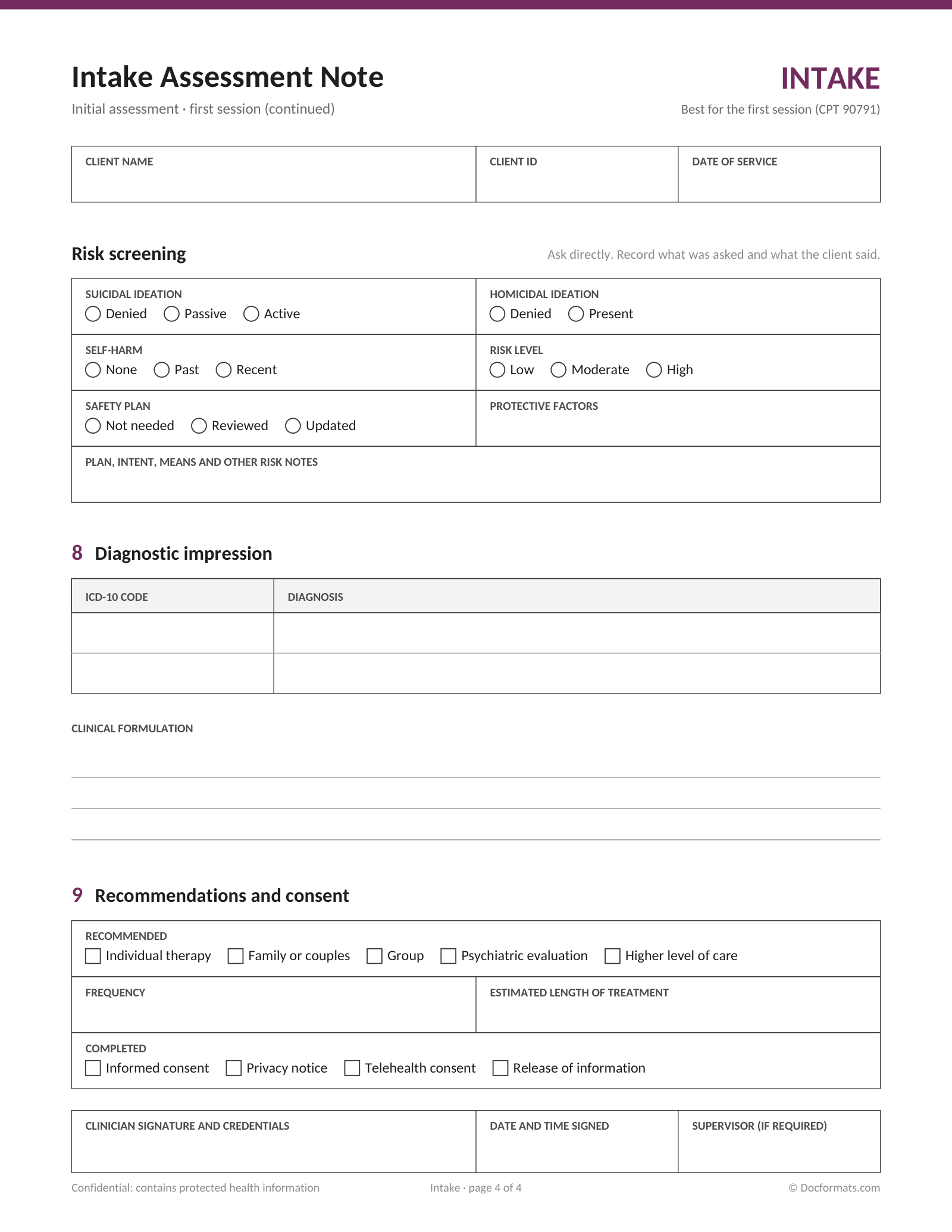


Intake Assessment Note
In group therapy (CPT 90853), each member needs a note of their own. The group summary, with the topic, facilitators and attendance, can be the same in every member’s note, and the rest of the note is about this member, with a participation rating, the group interventions they received and their progress toward their own goals. Other members appear by initials only, which keeps their names out of this member’s record.
Group Therapy Progress Note


Group Therapy Progress Note
Couples and family therapists writing up a conjoint session, billed as 90847 with the client present or 90846 without, can record everyone who took part on this note, with their relationship to the client and their consent. There’s room for each person’s view in their own words, which helps you keep the note balanced between them, and a list of patterns between people, such as pursue and withdraw or triangulation. Each person has their own homework, and the partner violence screen is meant for each partner alone.
Couples and Family Session Note


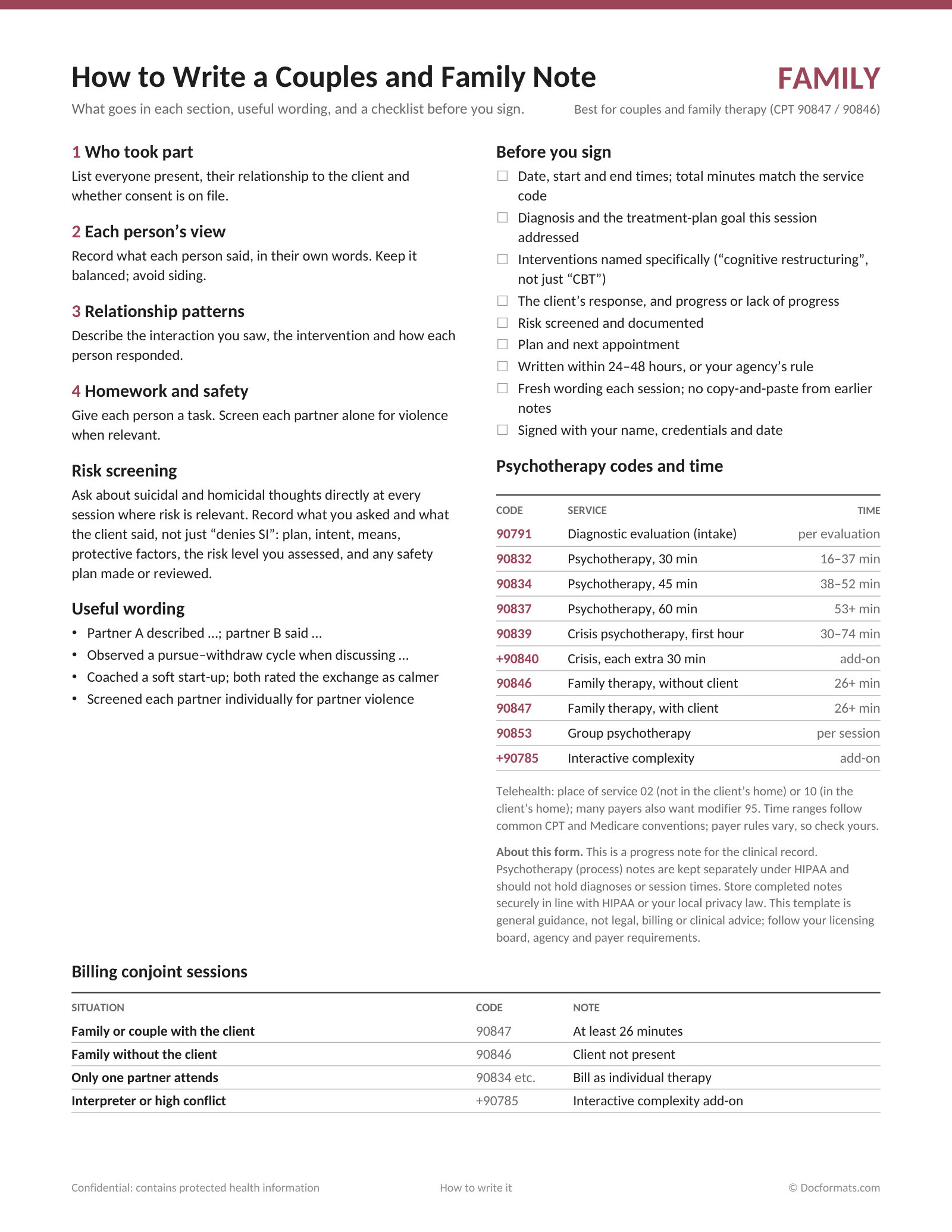
Couples and Family Session Note
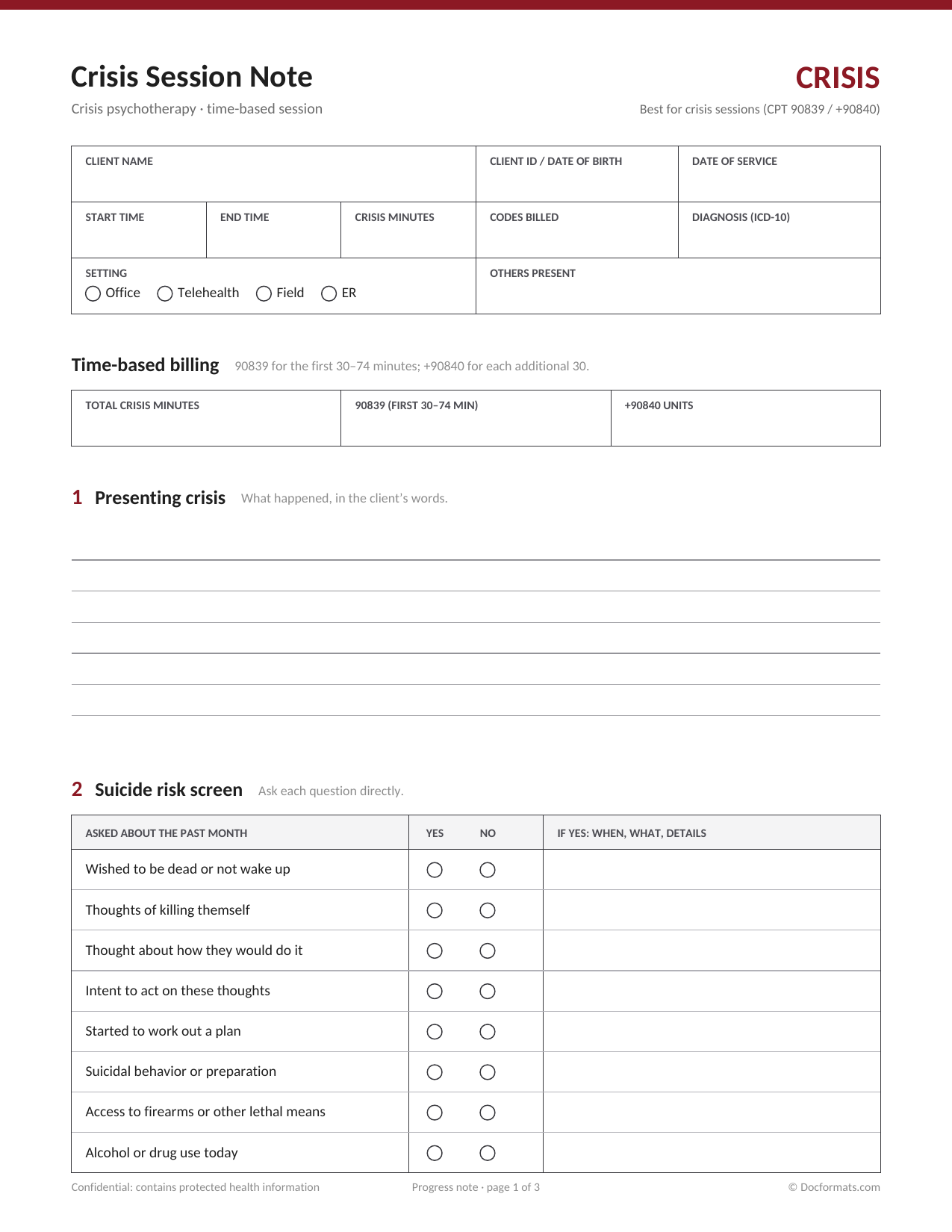
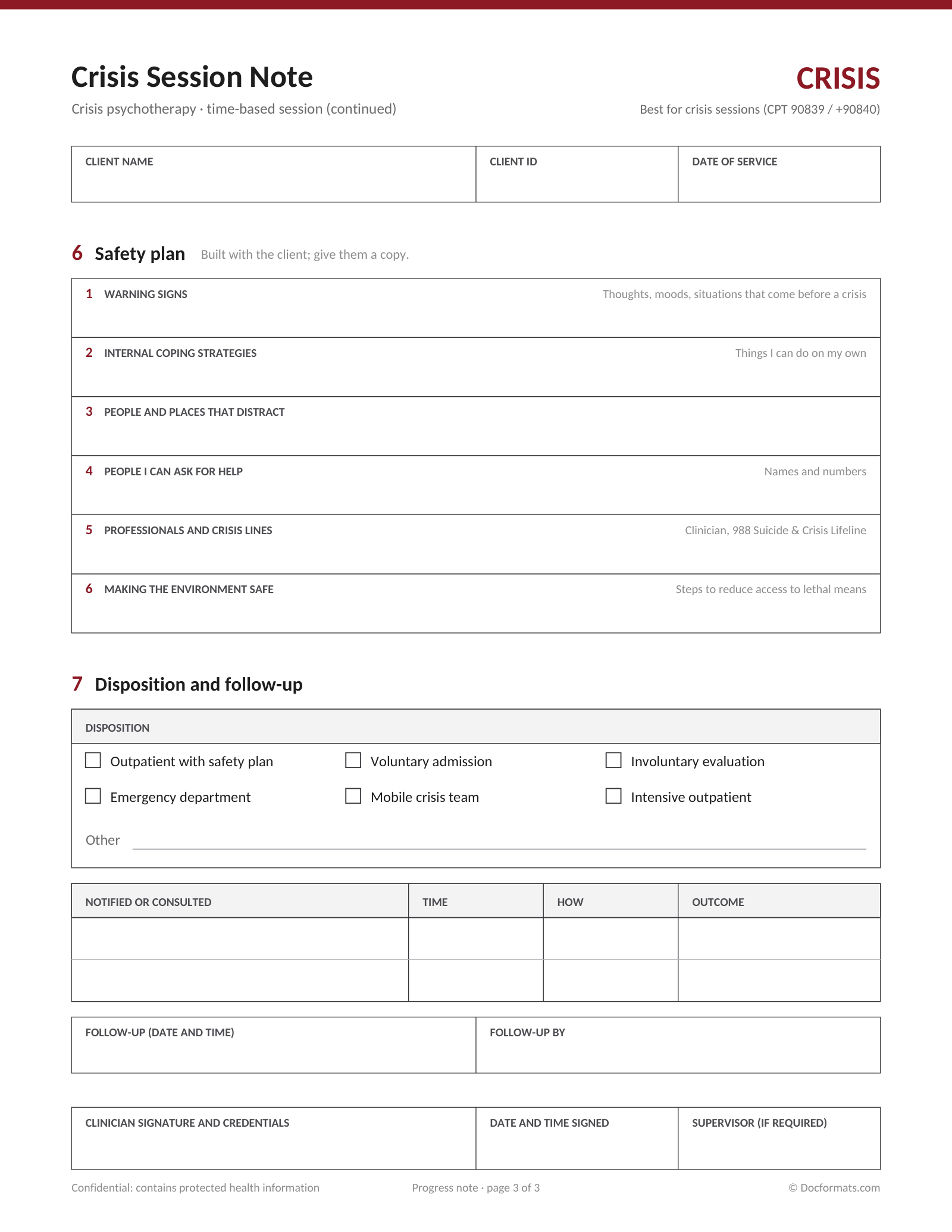
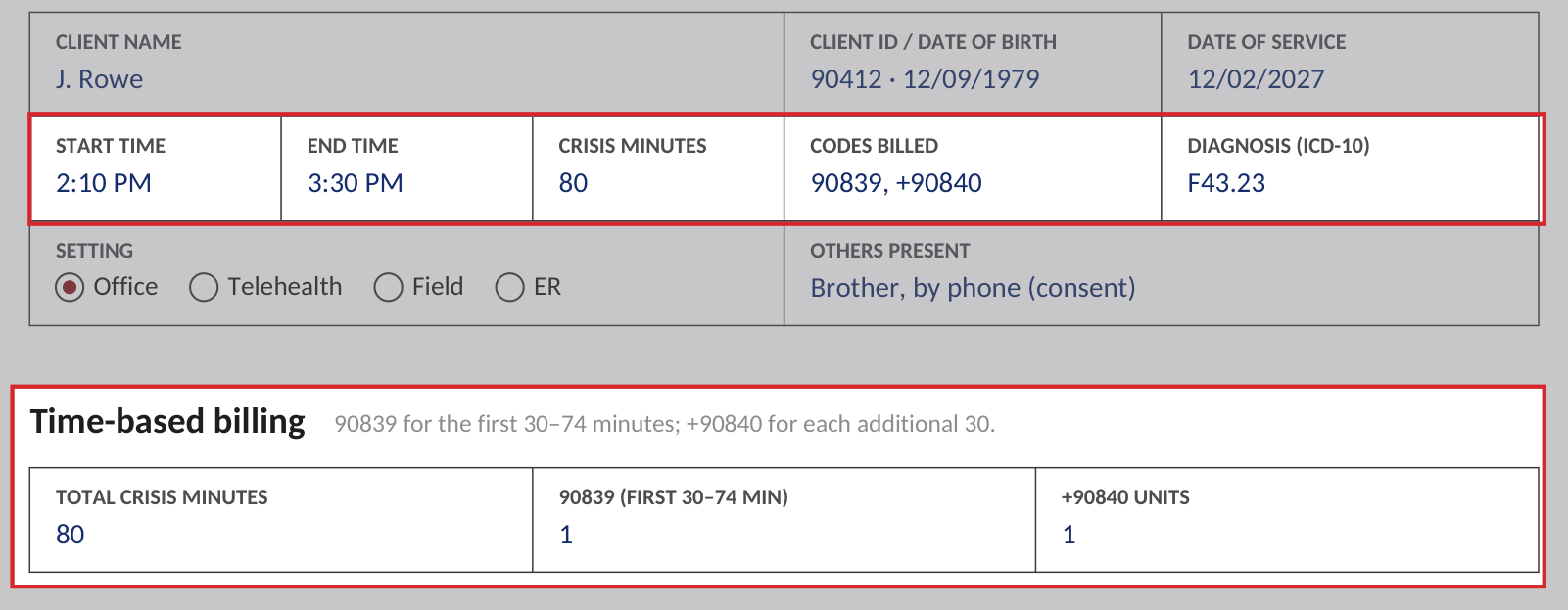
When a crisis takes up a whole session, you bill it by time with 90839 and the add-on +90840, and this is the note for that session. Its suicide risk screen has direct questions about the past month, including access to firearms or other lethal means and alcohol or drug use that day. Your overall risk judgment, from low to imminent, has space for your reasoning, which shows anyone reading the note why you chose the level of care you did. The note also has room for the safety plan you made with the client, the disposition, who you notified and the follow-up.
Crisis Session Note



Crisis Session Note
Video and phone sessions need a few extra facts confirmed every time, and the telehealth progress note has a verification block for them. In it, you record where the client is, with the address and state, how you confirmed who they are, where you are, the place of service and modifier, an emergency contact and the local emergency number, along with the consent checks. The note for the session is in the Data, Assessment and Plan format, with a line for any connection problems, such as a dropped call or a switch to phone. Recording the client’s location tells you which emergency services to call if risk rises during the session.
Telehealth Progress Note


Telehealth Progress Note
Many payers want a treatment plan reviewed every 30 to 90 days, and this review is the record of that check-in. Each goal has a status, met, progressing, no change or worse, and its measure at baseline, now and at target, which shows the change on the measure you used at the start. The client signs to show they took part in the review, and you record what changed in the plan and why.
Treatment Plan Review


Treatment Plan Review
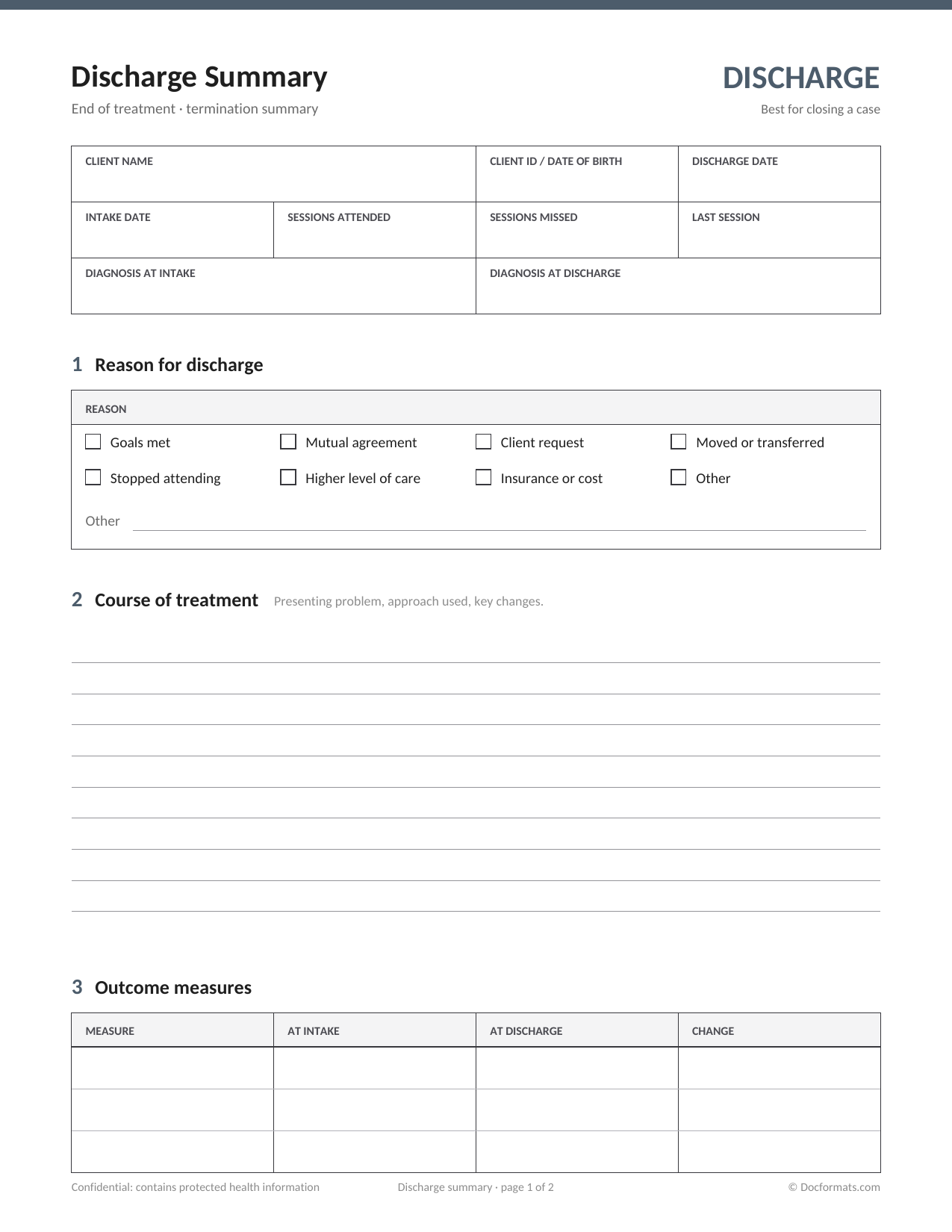
At the end of treatment, planned or not, the discharge summary is the closing record of the case. On it, you compare the diagnosis and outcome scores at intake with those at discharge, and record why the case closed, the sessions attended and missed, aftercare referrals with their contacts and a relapse-prevention plan. Anyone who picks up the case later, the client included, can see what changed and what to do if symptoms return.
Discharge Summary


Discharge Summary
When a client doesn’t show or cancels late, the one-page missed appointment note is your record of what happened and how you followed up. Each attempt to reach them has its own line with the date, method and outcome, along with the reason they gave, any safety concern and your next steps. The count of appointments missed in the last 90 days helps you apply your attendance policy the same way to every client.
Missed Appointment Note


Missed Appointment Note
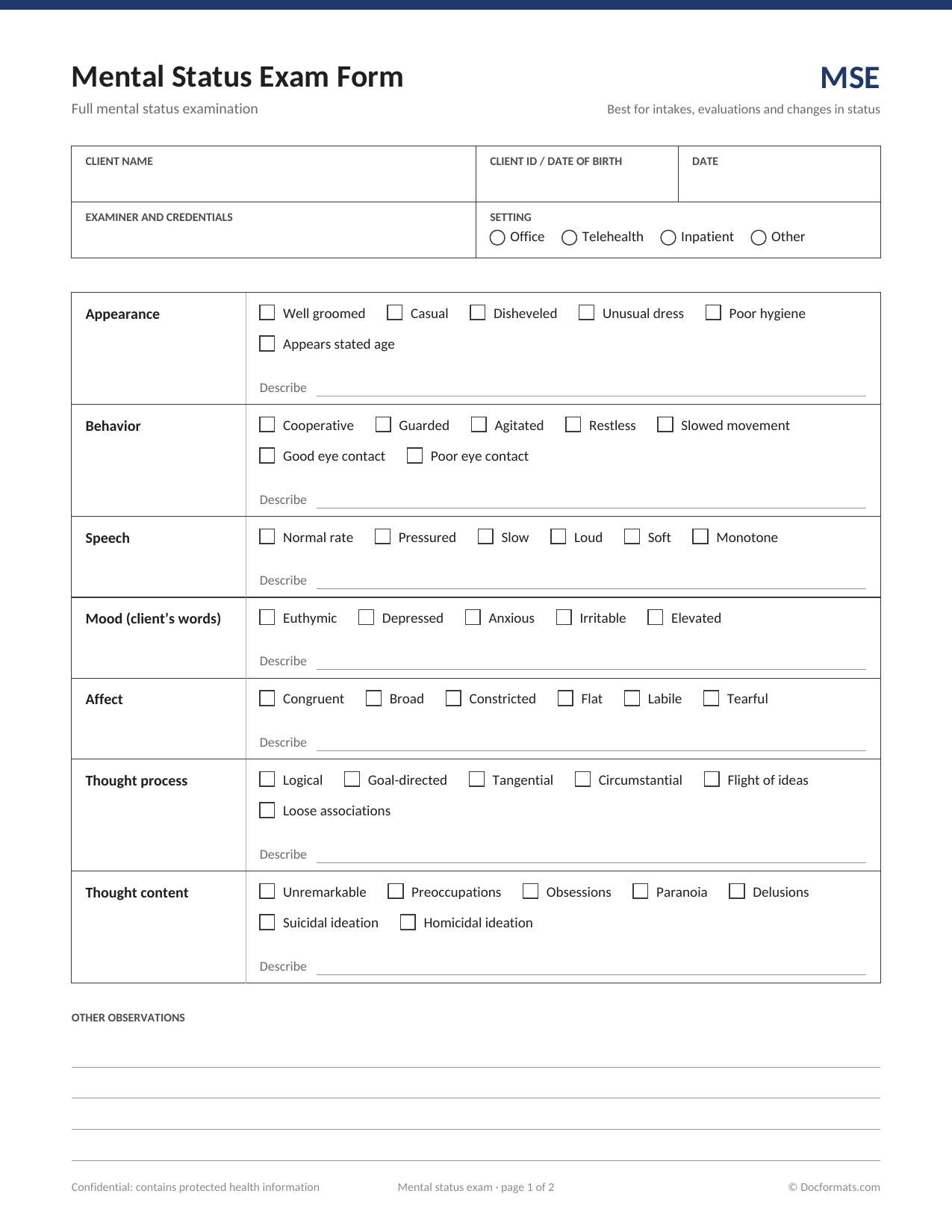
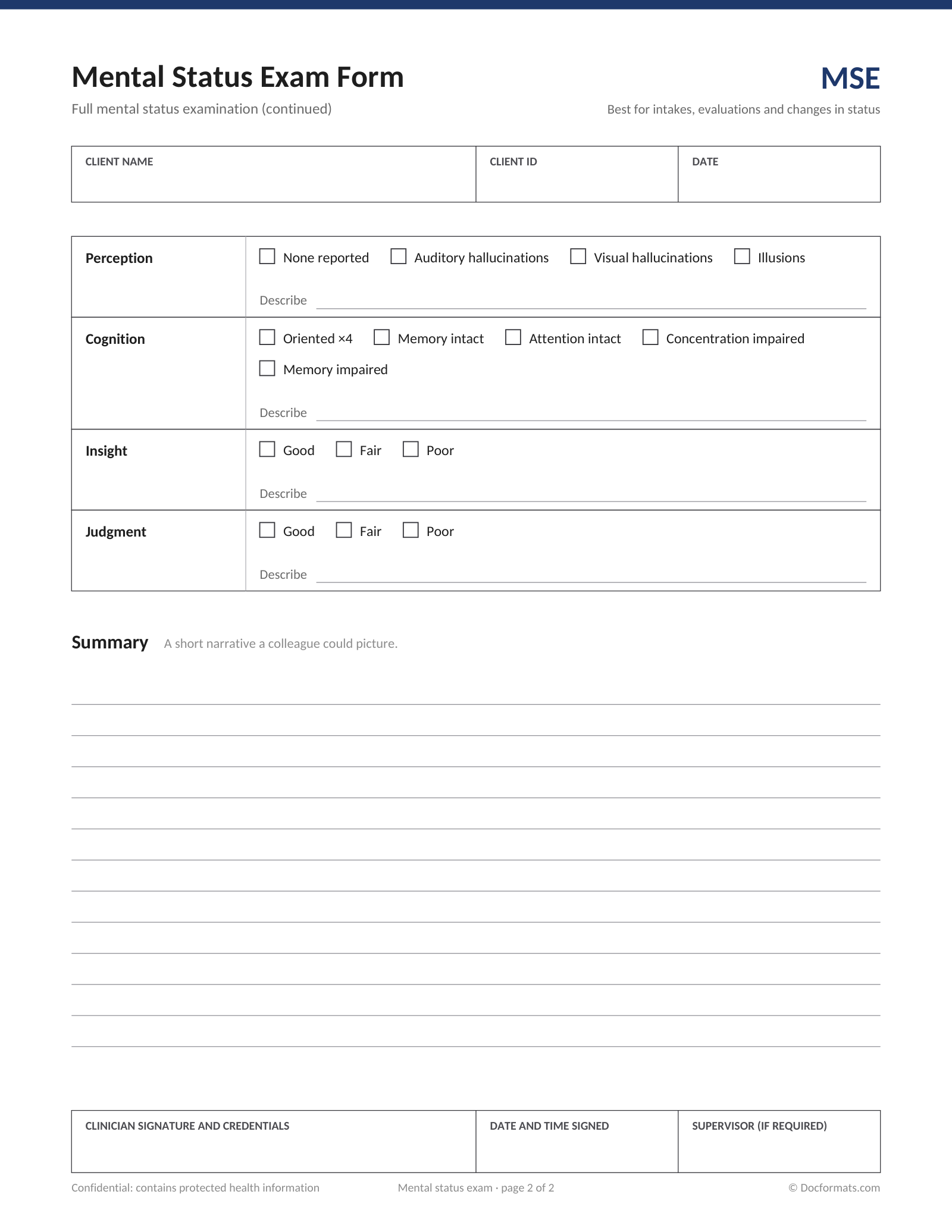
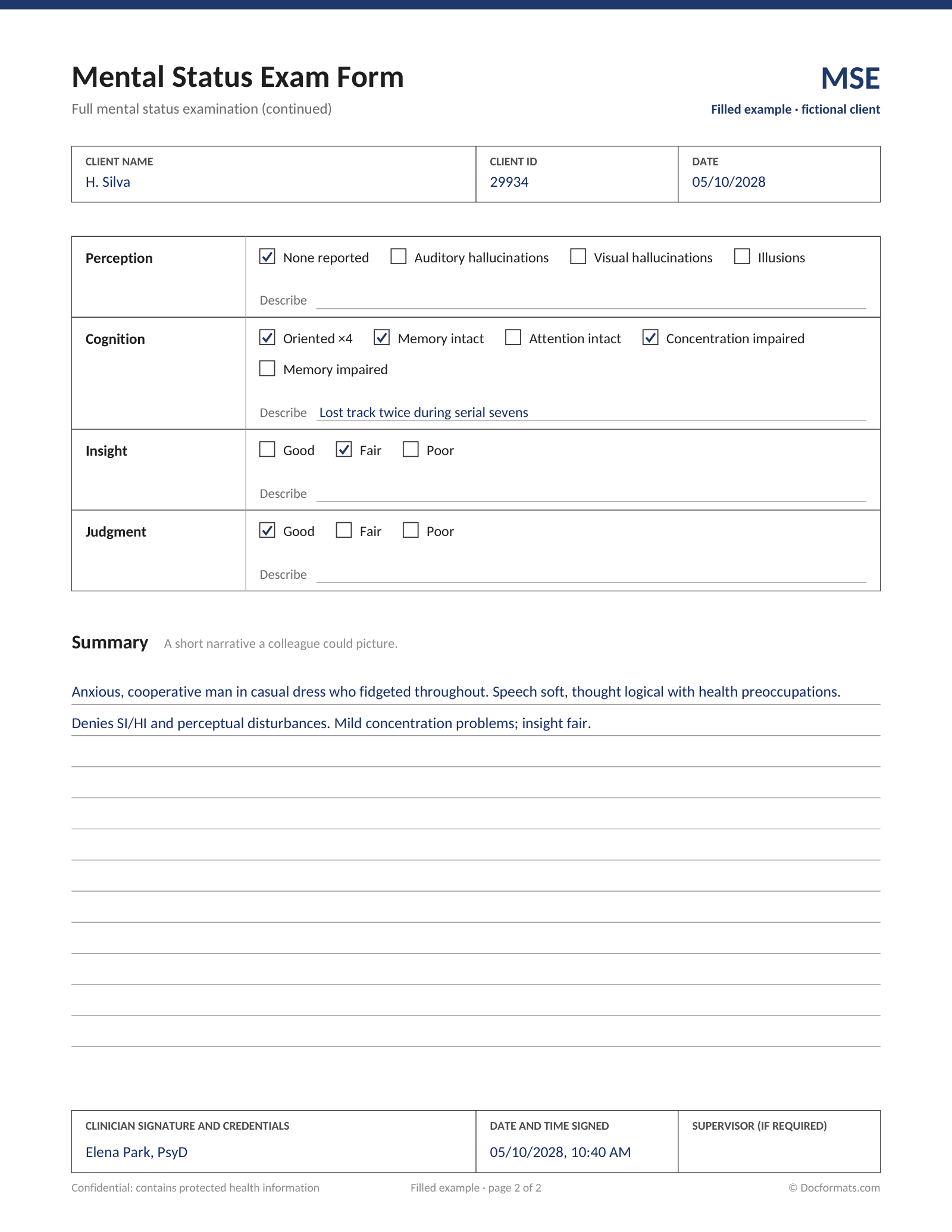
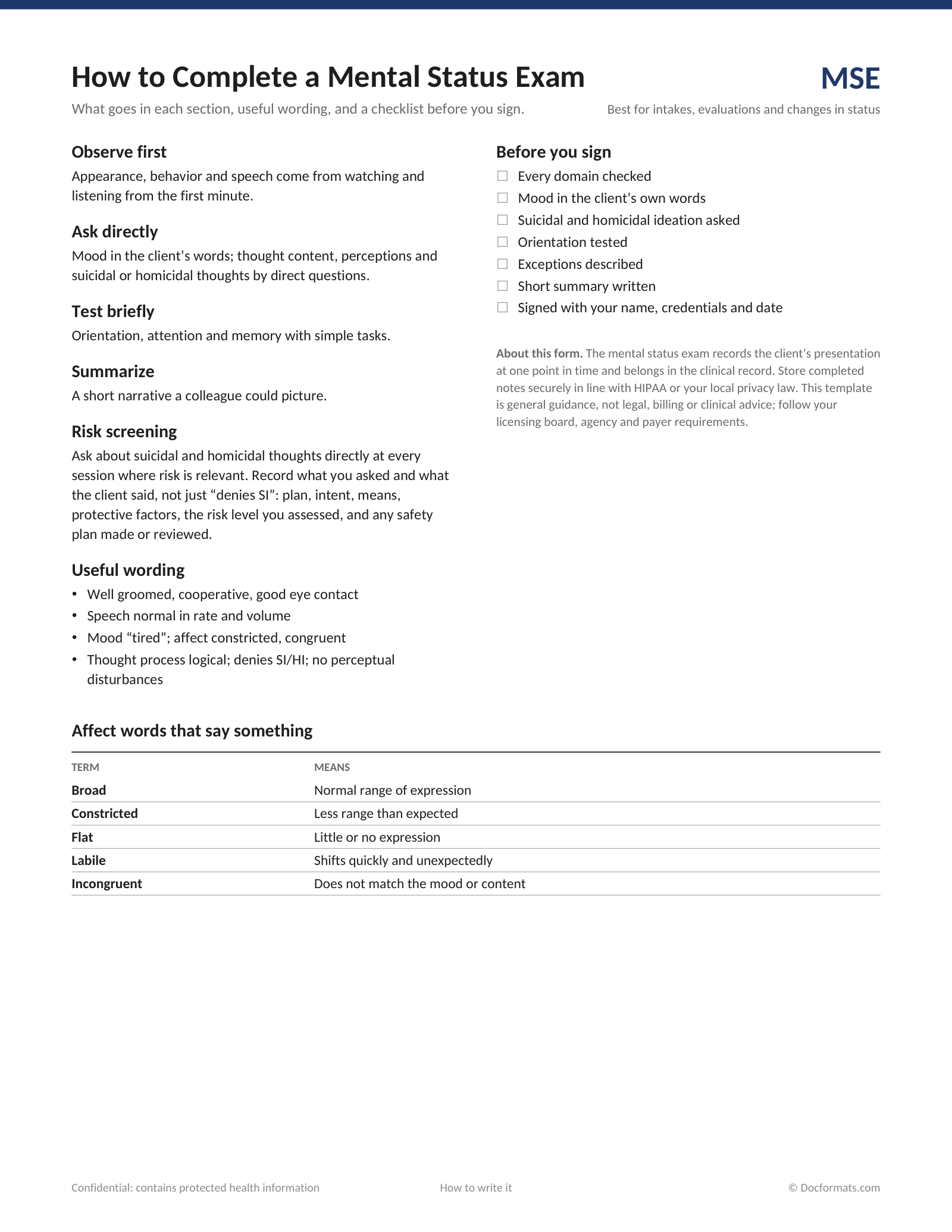
Clinicians doing an intake or an evaluation, or noticing a change in a client’s presentation, can record a full mental status exam on this form. Each area, from appearance and speech to perception, cognition, insight and judgment, has tick boxes for the common descriptions and a line to describe anything else, and mood is recorded in the client’s own words. With the short summary, you can give a colleague a picture of the client in a few lines.
Mental Status Exam Form

Mental Status Exam Form
Process notes are your private notes about a session, for your own thinking, and under HIPAA they have extra privacy protection when you keep them apart from the client’s record. On this template, you identify the client by a code or initials, then write the themes that stood out, your hypotheses, your own reactions and questions for supervision. They add to the progress note and never replace it.
Psychotherapy Process Notes


Psychotherapy Process Notes
Which Note Template Should You Use?
Your agency, payer or supervisor often decides the note format, and when they do, that’s the one to use. When the choice is yours, choose by your setting and the kind of session, and make every note complete in whichever format you pick.
| Template | Best for | Pages | Stand-out feature |
|---|---|---|---|
| SOAP Progress Note | Integrated and medical care | 2 | Client’s report and your observations kept apart |
| DAP Progress Note | Routine counseling sessions | 1 | A complete one-page note |
| BIRP Progress Note | Behavioral health and substance use | 2 | Target behaviors tracked week to week |
| GIRP Progress Note | Payers who want each session tied to a goal | 2 | A 0 to 4 rating for each goal |
| PIE Progress Note | Case management and nursing | 2 | A running flow sheet across contacts |
| SIRP Progress Note | Crisis and unscheduled contacts | 3 | A timeline and a safety plan |
| Intake Assessment Note | The first session (90791) | 4 | History questions and consent checks |
| Group Therapy Progress Note | Group psychotherapy (90853) | 2 | A shared summary and a rating for each member |
| Couples and Family Session Note | Conjoint sessions (90847, 90846) | 2 | Each person’s view and a partner violence screen |
| Crisis Session Note | A full crisis session billed by time | 3 | A direct suicide risk screen |
| Telehealth Progress Note | Video and phone sessions | 2 | Location and identity checked every session |
| Treatment Plan Review | 30, 60 or 90-day reviews | 2 | Baseline, current and target scores for each goal |
| Discharge Summary | Closing a case | 2 | Scores at intake and at discharge |
| Missed Appointment Note | No-shows and late cancellations | 1 | A log of every contact attempt |
| Mental Status Exam Form | Intakes, evaluations and changes in status | 2 | Tick boxes and a describe line for every area |
| Psychotherapy Process Notes | Your private impressions | 1 | Kept separate from the record |
SOAP or DAP
SOAP and DAP notes cover the same session. The difference is how you separate what the client tells you from what you observe. SOAP keeps them apart, with the client’s report under Subjective and your observations and scores under Objective, and that split is familiar to medical colleagues who read your notes. In DAP you write both under Data, which makes a shorter note that suits weekly counseling sessions. In both formats, Assessment is your clinical reading of the session, and under Plan you write what happens next.
Crisis Session Note or SIRP
Use the crisis session note when a crisis takes up a full session that you bill by time. Use the SIRP note for a quicker unscheduled contact, such as a phone call between sessions or a client who walks in without an appointment. Both include a safety plan, the disposition, who you notified and the follow-up.
Write Notes an Auditor Can Follow
Someone reviewing your note needs to see what you did, why the client needed it and how they responded, in a note written at the time. Here’s what each part of a note needs, in the order you’d write it.
Record the Session Details
Write the date, the start and end times and the total minutes, and check that the minutes match the service code. Medicare contractors’ billing articles say to choose the psychotherapy code closest to the actual time, with 16 to 37 minutes for 90832, 38 to 52 for 90834 and 53 or more for 90837. One contractor’s article also asks for the start and stop times or the total time to be recorded, and another’s says family therapy codes 90846 and 90847 can’t be reported for sessions under 26 minutes. Crisis codes count all the face-to-face time on that date, even when it isn’t continuous. The crisis session note has its own table for counting it. Every how-to page with codes includes the full code table. Your payer’s rules can differ, and you should check them too. CPT is a registered trademark of the American Medical Association.
For a telehealth session, record the place of service as well. In CMS’s code set, 10 means the client was at home and 02 means they were somewhere else, such as at work. Ask your payer which modifier it wants, as payers differ.
Name the Diagnosis and the Goal
Write the diagnosis with its ICD-10 code and the treatment-plan goal this session worked on. Naming the goal ties the session to the treatment plan and shows medical necessity, the clinical reason the client still needs treatment.

Name Each Intervention Precisely
Write what you actually did, such as cognitive restructuring of worries about work or motivational interviewing about the client’s reasons for change, instead of a label like “CBT”. A precise intervention tells anyone reading the note which skill you used and how it serves the goal.
Record the Client’s Response
Say how the client responded, with a rating or something you could see. “Rated distress 7/10 before the exercise and 4/10 after” shows a reviewer the change in numbers they can follow, and “responded well” leaves them guessing.

Ask About Risk and Record the Answers
At every session where risk is relevant, ask directly about suicidal ideation (SI) and homicidal ideation (HI). Record what you asked and what the client said, along with plan, intent, means, protective factors and the risk level you judged. “Denies SI” on its own leaves out the question you asked. When you make or review a safety plan, include the 988 Suicide & Crisis Lifeline, which anyone can call or text.

Set the Plan and the Next Appointment
Write the focus for the next session, any homework, referrals or changes to the treatment plan, and the date and time of the next appointment. A plan with a date shows that treatment is continuing, and it reminds you where to pick up next time.
Sign on Time and Mark Late Entries
Sign with your name, credentials, the date and the time. If you’re an associate or intern, your supervisor co-signs on the supervisor line. Many agencies and payers set a window for finishing notes, often 24 to 48 hours, and Medicare expects each service to be written up at the time it’s given. If you add to a note later, mark it as a late entry with the date and your name. Medicare’s manual says the date and author of any amendment, correction or delayed entry should be clear.
Before you sign, check that:
- the total minutes match the service code you’re billing
- the diagnosis and the goal this session worked on are named
- each intervention is named precisely
- the client’s response has a rating or something you observed
- you’ve recorded the risk questions you asked and the client’s answers
- the plan and the date of the next appointment are written down
- the wording is fresh for this session, with nothing copied from the last note
- any late entry is marked as late, with the date you wrote it
Common Documentation Mistakes
Each of these happens easily in a busy week, and each has a plain fix you can make before you sign.
- Vague language. “Client seemed better” can’t be checked by anyone. Write what changed and by how much, such as two panic attacks this week, down from five.
- Opinion written as fact. “Client was manipulative” is a judgment. Write what you saw and heard, and keep your interpretation in the Assessment, where it reads as your clinical view.
- Copied notes. A note pasted from last week reads the same whatever happened in the session. Write each session fresh, even when progress is slow.
- Risk left blank. An empty risk section looks like a question you never asked. Record what you asked and what the client said, even when the answer is no.
- Time and code that don’t match. A 45-minute session billed as 90837 is a mismatch a reviewer can spot. Check the total minutes against the code before you sign.
- Late entries not marked as late. A note added days later without a label looks as if you wrote it at the time. Mark it as a late entry with the date you wrote it.
Here are three observations written both ways, once vaguely and once so they can be measured.
Vague
- Client is sleeping better
- Client was anxious in session
- Client is making progress
Measurable
- Sleeping 7 hours on 5 nights this week, up from 4 hours a night
- Fidgeted and spoke quickly when talking about the job interview
- GAD-7 11 today, down from 15 at intake; target is below 10
If you write it this way, a colleague covering your caseload or a reviewer can see the change for themselves, and you can compare the same numbers at the next treatment plan review.
Progress Notes and Psychotherapy Notes
Progress notes are part of the clinical record. They include the session details, diagnosis, symptoms, interventions, the client’s response, risk, the plan and progress, and payers can review them. Psychotherapy notes, also called process notes, are your private impressions of a session, kept separate from the rest of the record.
HIPAA defines psychotherapy notes as notes a mental health professional writes about the conversation in a session and keeps separate from the rest of the medical record. Most uses and disclosures of them need the client’s authorization, and they’re outside the right of access clients have to their own records under HIPAA. State laws on access vary, and you should check your own state’s rules. The same definition leaves out the following, and you record them in the progress note instead:
- medication prescribed and monitored
- session start and stop times
- the kind and frequency of treatment
- results of clinical tests
- any summary of diagnosis, functional status, the treatment plan, symptoms, prognosis or progress
Important:
Writing any of these into your process notes doesn’t make them private. HIPAA’s definition keeps them out of psychotherapy notes wherever you write them. Medicare’s manual tells its reviewers the same, and tells them never to ask a provider for psychotherapy notes.
If you keep process notes, use our psychotherapy process notes template, where you identify the client by a code or initials and keep diagnoses, codes and session times out.
FAQs
SOAP separates the client’s report (Subjective) from your observations (Objective), then adds Assessment and Plan. DAP puts both under Data. BIRP centers on the client’s behavior and how they responded to what you did. GIRP rates progress on each treatment-plan goal. PIE is a running flow sheet of problems, interventions and evaluations across many contacts. SIRP records a crisis or unscheduled contact.
Payers mainly look for the required content and for time that matches the code you billed. If your payer or agency names a format, use the format they name. Otherwise, a note that’s complete every session matters more than which format it’s in.
Long enough that someone reading it can follow the session without asking you about it. A short DAP note is fine when every part is there.
Follow your agency’s and payer’s rules; many expect notes within 24 to 48 hours. Medicare expects each service to be written up at the time it’s given. If you write a note later, mark it as a late entry.
Yes. Each writing line is its own field, and you press Tab to move to the next one. You can also print them and write by hand on the same lines.
HIPAA compliance depends on how you store and share completed notes, and the templates are designed with that in mind, with a confidentiality footer on every page. Keep completed notes on an encrypted device or in your electronic health record (EHR), limit who can open them, and avoid sending them as email attachments.
They’re optional, and many clinicians don’t keep them. If you do, keep them apart from the client’s record, progress notes included.
You can use them in your practice or agency at no cost. Please don’t resell them or post them on another website; link to this page instead.
Yes. Every note has a supervisor line in the signature row for a co-signature.
Not as therapy. Medicare doesn’t pay for missed appointments, and under its policy a practice that charges Medicare patients a missed-appointment fee must charge non-Medicare patients the same way. For other payers, check your contract before you charge a fee.
Final Thoughts
Your notes are easiest to compare when every form in a client’s record uses the same measures. If you score a PHQ-9 or GAD-7 at intake, score it again in your progress notes, at each treatment plan review and at discharge, and the change over the whole course of treatment shows in numbers. If family history comes up at intake, our genogram templates help you draw family relationships across generations.
References
- eCFR, “45 CFR 164.501, Definitions” (psychotherapy notes)
- eCFR, “45 CFR 164.508, Uses and disclosures for which an authorization is required“
- eCFR, “45 CFR 164.524, Access of individuals to protected health information“
- CMS, “Medicare Program Integrity Manual, Chapter 3” (sections 3.3.2.5 and 3.3.2.6)
- CMS, “Place of Service Code Set“
- CMS Medicare Coverage Database, “Billing and Coding: Psychiatric Diagnostic Evaluation and Psychotherapy Services (A57520)“
- CMS Medicare Coverage Database, “Billing and Coding: Psychiatry and Psychology Services (A56937)“
- CMS, “MLN Matters MM5613, Charges for Missed Appointments“
- SAMHSA, “988 Suicide & Crisis Lifeline“


