
A warning letter is a formal notice issued in response to undesirable behavior or a breach of policy, serving as a crucial intervention across various contexts. Whether it’s in the corporate sphere between employers and employees, between landlords and tenants, or as part of regulatory compliance, the warning letter is a foundational step towards rectifying issues before they escalate. This communication is not just a preliminary action but a documented reminder of responsibilities and the consequences of not adhering to agreed-upon standards or regulations.
Before proceeding with a warning letter, it is typically advisable to engage directly with the individual or party involved to discuss the problem and seek an amicable resolution. However, when informal attempts do not yield the desired improvements, a warning letter becomes a formalized method of addressing the issue. It encompasses detailing the specific infringement, providing clear expectations for correction, and outlining the consequences if the situation remains uncorrected.
The reasons for issuing a warning letter can be diverse, including poor performance, misconduct, non-compliance with legal or contractual obligations, safety violations, and more. Crafting a warning letter requires a nuanced approach that balances firmness with clarity, ensuring that the message is not only heard but also that it provides a clear pathway for compliance or improvement.
Warning Letter (Templates & Samples)
Attendance Warning Letter
An Attendance Warning Letter is a formal communication sent to an employee by an organization, highlighting irregularities or inconsistencies in their attendance record, thereby emphasizing the need for improved punctuality and regular presence. The provided sample offers a detailed structure with all essential elements, from addressing the recipient to outlining specific instances of absences or late arrivals. With easy-to-fill brackets, users can seamlessly adapt the content to their specific situations, ensuring clarity and professionalism in conveying attendance concerns to the employee.

Disciplinary Notice
A Disciplinary Notice is a formal document issued by an employer to an employee to address and document a specific violation or misconduct in the workplace. The provided template serves as a structured framework, detailing essential information such as the nature of the violation, previous warnings, actions taken, and possible consequences for further infractions. By using this format, employers can ensure a consistent and clear approach to handling disciplinary matters, while employees receive a transparent understanding of the issue and the steps needed for rectification.

Warning Letter to Employee
A Warning Letter to an Employee is a formal written communication from an employer to an employee, highlighting specific behaviors, actions, or performance issues that are unsatisfactory or in violation of the company’s policies. The template provided offers a structured format that covers all essential elements, from describing the issue to outlining potential consequences. With sample data in place, users can easily fill in the relevant details, ensuring clarity and professionalism in their communication with the employee.

Warning Letter
A warning letter is a formal document sent by an employer to an employee to address and rectify certain unacceptable behaviors or violations in the workplace. The template provided previously offers a structured format, which includes all necessary fields and sample data, to effectively communicate concerns, document specific incidents, and specify potential consequences if the undesired behavior continues. This format ensures clarity and professionalism, facilitating better understanding between both parties.

Warning Notice
A Warning Notice is a formal document issued by an authority or organization to an individual or entity, alerting them of a violation, misconduct, or non-compliance with established rules, policies, or procedures. The detailed Warning Notice provided above serves as a versatile framework to address varied situations, offering clear sections for defining both the nature of the incident and the corrective actions recommended. By using this structured format, users can ensure consistent and clear communication of important details, thereby enhancing the effectiveness and understanding of the notice.

Warning Letter to Tenant for Violations
A Warning Letter to Tenant for Violations is a formal document sent by a landlord or property manager to a tenant to notify them of breaches or non-compliance with the terms and conditions of their lease agreement. The template provided offers a structured format that outlines the specific violations, refers to the relevant clauses in the lease, and communicates potential consequences if the issues aren’t rectified. It aids landlords in addressing issues efficiently and serves as a written record of the notice, ensuring clarity for both parties involved.

Final Warning Letter
A Final Warning Letter is a formal document issued by an employer or organization to an individual, addressing a specific misconduct or unsatisfactory performance, often after previous warnings or communications have been made on the same issue. The provided sample offers a structured format covering all pertinent details, such as incidents leading to the warning, expectations for improvement, and acknowledgment of receipt. This format ensures clarity and thoroughness, allowing users to adapt it for a variety of situations without overlooking essential information.

Staff Warning Notice
A Staff Warning Notice is a formal document used by organizations to address and document instances where an employee’s behavior or performance does not meet the expected standards or violates company policies. The provided template offers a structured format, detailing the nature of the incident, the specific company policy violation, any previous warnings, the impact of the behavior, expected corrective actions, potential consequences, and spaces for necessary acknowledgments and signatures. This format ensures that all crucial aspects of the warning process are covered, facilitating clear communication between the management and the employee.

Warning Letter from Santa
A Warning Letter from Santa is a playful yet effective method used by parents or guardians to address concerning behavior in children during the festive season, gently reminding them of the importance of good behavior to stay on Santa’s “nice” list. The provided format serves as a customizable foundation, equipped with sample data, ensuring ease of personalization. This allows caregivers to pinpoint specific actions and encourage a positive change in behavior, all while maintaining the enchanting spirit of Christmas.

Warning Letter to Tenant
A Warning Letter to a Tenant is a formal written notice sent by a landlord or property management to a tenant, addressing specific issues or violations related to the terms of their rental or lease agreement. The provided sample offers a structured format for landlords to clearly communicate the nature of the tenant’s infraction, cite relevant clauses from the lease agreement, and detail the corrective actions required. By using this format, landlords can ensure a clear and concise communication, aiming for an amicable resolution while keeping a documented record of the communication.

Absence Without Notice Warning Letter

Employee Warning Letter for Attendance

First and Final Warning Letter Template

Formal Warning Letter to Employee
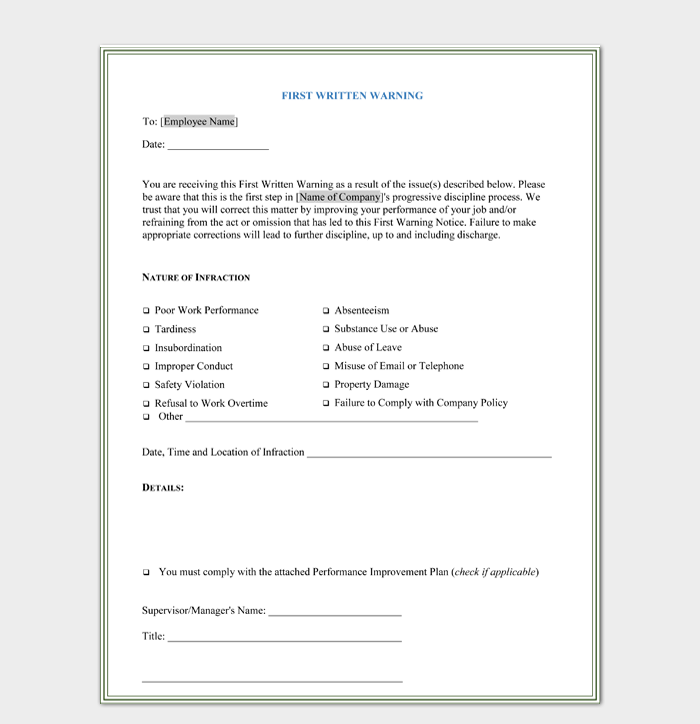
Formal Written Warning Letter Example

Free Sample Warning Letter for Poor Performance

Late Rent Payment Warning Letter

Sample Employee Warning Letter Poor Performance

to Contractor for Poor Performance

Student Conduct Warning Letter

Warning Letter Format for Poor Performance

Warning Letter to Student for Absence

Warning Letter to Student Format

Crafting a Comprehensive Warning Letter: Key Elements
A well-structured warning letter is a pivotal document that can help navigate through workplace issues effectively. To construct a meaningful and legally sound warning letter, consider including the following components:
- Clear Description of the Issue: Define the problem with enough detail to leave no ambiguity about the behavior or performance in question. Use specific instances and objective terms to describe the issue. Avoid jargon or language that could be interpreted as personal criticism.
- Reference to Previous Interactions: If there have been prior verbal or written communications regarding the concern, mention these to establish the history and ongoing nature of the issue. This underscores the seriousness of the situation and reminds the recipient that they have had opportunities to address the matter.
- Expectations for Improvement: Outline a clear action plan that the recipient can follow. This could involve specific behavioral changes, performance metrics to be met, or steps to ensure compliance. The aim is to provide a roadmap for improvement that is realistic and measurable.
- Timeframe for Correction: Offer a specific deadline or time period for the employee to show improvement or compliance. Be sure to allow enough time for genuine change to occur, and consider what is reasonable in the context of the issue.
- Outline of Consequences: Explain what will happen if the employee fails to meet the expectations set forth in the letter. This might include a range of potential disciplinary actions. It’s crucial that these consequences are consistent with company policy and employment law.
- An Offer of Support: While not mandatory, offering help, such as additional training or resources, shows the company’s willingness to assist the employee in their improvement and can be conducive to a positive outcome.
- A Call to Action: Conclude with an invitation for the employee to discuss the contents of the letter or to seek clarification, reinforcing the company’s open-door policy and encouraging a proactive approach to resolving the issue.
Remember, the tone of the warning letter should be professional and focused on resolving the issue at hand. It’s not personal—it’s about performance and behavior in a professional setting.
Lastly, always review the company’s policies and any relevant legal considerations before sending out the letter to ensure compliance with internal and external standards.
Warning Letter Format
Date:
Name of the employee
Employees address
Re: Warning for [reasons/issue]
Dear [employees first name],
Subject: Formal Warning Concerning Your Performance
Dear [Employee’s First Name],
I am writing to formally address a concern regarding your performance as [Employee’s Job Title], specifically related to not meeting the targets as outlined in your [appointment letter/job description/previous performance appraisal]. This issue was previously discussed in our meeting on [Insert Date of Discussion], where it was noted that your performance has not met the expectations set forth by our organization.
Despite the guidance provided and the resources made available to you, there has been no satisfactory improvement in your performance. As such, we must proceed with a more formal approach to help you get back on track.
The following points outline the action plan and expectations moving forward:
Action Required: [Detail the specific actions the employee must take to meet their targets. Be clear and precise, ensuring the employee understands what is expected of them.]
Timeframe: [Specify the period within which the employee is expected to improve. Provide specific dates for interim reviews and the final assessment.]
Support Available: [If applicable, mention any support or resources the company will provide to assist the employee in meeting their targets.]
Consequences: Should there be no significant improvement in your performance within the next [specify timeframe], please be advised that we will have to proceed with further disciplinary actions, which could include [list potential consequences, ensuring they are in line with company policy].
Your acknowledgment of this letter is required. Please sign and return one copy of this letter and any accompanying documents, retaining a copy for your records. Your signature will act as acknowledgment of receipt and understanding of the contents of this letter, not necessarily agreement with the circumstances.
We believe in your ability to contribute positively to our team and deliver the results we know you are capable of. We hope to see a turnaround in your performance and are here to support you in achieving these objectives.
Thank you for your immediate attention to this matter. Should you have any questions or need clarification, please do not hesitate to reach out to me directly.
Sincerely,
[Your name]
[Job Title]
Sample Warning Letter to Employee
Subject: Notice of Underperformance and Need for Improvement
Dear Melvin,
I hope this message finds you well. As part of our ongoing commitment to excellence and regular performance evaluations, it has come to our attention that, unfortunately, your recent work has not met the company’s required performance standards as outlined in your role’s objectives.
Please consider this letter a formal reminder of the critical importance of meeting your performance targets. Adaptor Solutions values your contributions, and we are confident in your potential to excel. However, it is essential to address areas where expectations are not being met.
In our meeting on [Insert Date], specific performance targets were discussed and agreed upon. It is of concern that these have not been achieved. To reiterate, we require all team members to meet their objectives, as these are integral to the operational success of our team and company.
The purpose of this notice is to:
Highlight the Gap: Clearly identify where your performance is falling short in comparison to the agreed-upon targets.
Encourage Improvement: Motivate you to take proactive steps towards enhancing your performance. We are here to support you, and we encourage you to utilize the resources available to you.
Establish Monitoring Period: Please be aware that over the next six months, we will be closely monitoring your performance. It is imperative that in this period, noticeable and sustained improvement is observed.
Explain Consequences: It is our duty to inform you that if performance does not improve to meet the required standards, we may have to take more formal action which could lead to sanctions as per our company policy. This is not our preferred course of action, and we believe it can be avoided through collaborative effort.
Melvin, we urge you to use this period as an opportunity for growth. Please feel free to reach out to me directly or schedule a meeting to discuss any challenges you are facing or support you may need in meeting your targets. We are committed to your professional development and are prepared to assist in any way that will help you succeed in your role.
Thank you for your immediate attention to this matter. We look forward to seeing a positive change in your performance and are optimistic about your ability to return to the high standard of excellence we know you are capable of.
Yours sincerely,
Louis Leaky
Human Resource Manager
Adaptor Solutions
Sample Warning Email
Subject: Formal Notice: Immediate Attention Required for Punctuality and Conduct Concerns
Dear Ms. Agatha,
I trust this email finds you well.
It has come to my attention over the past three weeks that your punctuality has not been in line with the standards we uphold at our company. Timeliness is a fundamental expectation at [Company Name], and despite a verbal reminder issued on [Date], there has not been an observable improvement in your arrival times.
Additionally, reports of unprofessional behavior and the use of inappropriate language have been brought to my notice. These allegations are serious and, if substantiated, represent a breach of our professional conduct guidelines.
Let me take this opportunity to remind you that adherence to company policies is non-negotiable, and every employee’s behavior reflects on the organization as a whole. As someone with substantial tenure at [Company Name], your actions set an example for others, and it is crucial that this example is in line with our core values.
I understand that there may be underlying issues that contribute to these behaviors, and I want to extend my support should you need assistance. Whether it’s work-related stress or personal challenges that are impacting your conduct, our company offers counseling services that can help.
Please consider this email a final warning. We need to see immediate improvement in both your punctuality and professional conduct. Failure to address these issues promptly will result in disciplinary action, up to and including termination of your employment.
I would like to schedule a meeting with you at your earliest convenience to discuss these matters further and to explore how we can facilitate a path to rectify these concerns. Please respond to this email with a suitable time for you to meet within the next two business days.
We value your contributions to our company and believe in your potential to overcome this setback. We are here to support you through this process.
Thank you for your immediate attention to this matter.
Warm regards,
Victoria Mark
HR Manager
[Company Name]
FAQs
Before issuing a warning letter, it’s advisable to document any incidents or patterns of behavior that warrant the warning. It’s also best practice to have a meeting with the employee to discuss these concerns directly, allowing them to respond to the issues raised.
Yes, an employee has the right to challenge a warning letter, especially if they believe it is unjust or the facts are incorrect. It’s important for employers to have a clear process in place for employees to submit their grievances or disputes regarding warnings.
While not always necessary, it is often beneficial to have a witness present, especially if you anticipate that the warning may be contentious. The witness, often an HR representative, can attest to the fair delivery of the letter and the content of any discussion.
It’s common practice to ask the employee to sign the warning letter to acknowledge that they have received and understand it, but not necessarily that they agree with it. If they refuse to sign, you can note their refusal on the letter and have a witness sign to confirm delivery.
If there’s no improvement after a warning letter, the employer may need to take further action as outlined in the company’s disciplinary procedures. This could range from additional support and training to further disciplinary actions, including potential termination.
Conclusion
A warning letter serves as a critical instrument within an organization’s disciplinary toolkit, meant to rectify employee infractions and guide them back on track. It’s essential that such correspondence is crafted with precision, embodying a tone that is firm yet supportive, underpinned by a thorough understanding of legal frameworks to ensure fairness and compliance. When executed properly, warning letters not only address immediate issues but also contribute to a culture of accountability and open communication, which are cornerstones of a robust and productive work environment.


