In the ever-evolving digital landscape, organizations must remain vigilant in safeguarding their valuable information assets from a wide array of threats. An essential tool in fortifying their digital fortress is a robust Security Risk Assessment (SRA), which provides a comprehensive blueprint for identifying, evaluating, and mitigating potential vulnerabilities. In this article, we will delve into the intricacies of a meticulously crafted Security Risk Assessment Template, designed to streamline the assessment process and empower organizations to make informed decisions, bolstering their defenses against the dynamic challenges posed by cyber adversaries.
What Is Security Risk Assessment Template?
A Security Risk Assessment Template is a structured document or tool that serves as the foundation for conducting a thorough and consistent evaluation of an organization’s information security posture. It is designed to facilitate the identification, analysis, and prioritization of security risks that may compromise the confidentiality, integrity, and availability of the organization’s critical information assets.
The template typically includes predefined categories, guidelines, and criteria that help security professionals methodically assess the organization’s security measures, aligning them with best practices and industry standards. By leveraging a well-structured template, organizations can streamline their risk assessment process, ensuring that no crucial aspect of their security is overlooked. Additionally, it promotes a comprehensive understanding of the organization’s risk landscape, enabling informed decision-making and the implementation of effective risk management strategies.
Why Is Security Risk Assessment Template Important?
Security risk assessment is a crucial process that organizations must undertake to safeguard their operations and protect against potential threats. However, conducting a comprehensive security risk assessment can be a daunting task, particularly for those without experience in risk management. That’s where security risk assessment templates come in. Here are some of the reasons why security risk assessment templates are important:
- Systematic Approach: A well-designed template provides a structured and systematic approach to the risk assessment process, ensuring that all relevant aspects of an organization’s security posture are considered and analyzed.
- Consistency and Standardization: Utilizing a template promotes consistency and standardization across different risk assessments within the organization, allowing for more accurate comparisons and trend analysis over time.
- Efficiency and Time Savings: With predefined categories and guidelines, a Security Risk Assessment Template streamlines the assessment process, saving valuable time and resources for organizations.
- Compliance and Regulatory Requirements: A template helps organizations meet and demonstrate compliance with various industry standards, regulations, and legal requirements, such as GDPR, HIPAA, or PCI DSS.
- Prioritization of Security Investments: By identifying and prioritizing risks, a template enables organizations to make informed decisions on allocating resources and implementing effective security measures, ensuring maximum return on investment.
- Improved Decision-Making: A Security Risk Assessment Template supports a data-driven approach to risk management, providing valuable insights for decision-makers to develop and implement strategic security initiatives.
- Enhanced Communication and Collaboration: A standardized template facilitates better communication and collaboration among various stakeholders, including IT teams, senior management, and third-party vendors, fostering a unified approach to risk management.
- Continuous Improvement: By regularly updating and refining the template based on new threats, vulnerabilities, and technological advancements, organizations can maintain a proactive security posture and continuously improve their risk management strategies.
- Incident Response Preparedness: A thorough risk assessment using a template helps organizations to better understand their vulnerabilities and be better prepared for potential security incidents, enabling more effective and timely incident response.
- Building Trust and Reputation: A comprehensive security risk assessment backed by a well-structured template demonstrates an organization’s commitment to information security, fostering trust among customers, partners, and stakeholders, and enhancing the organization’s overall reputation.
Building Security Assessment Template
If you’re new to a building or not familiar with its security needs, using a building security risk assessment template can be a useful tool. Such templates typically provide guidance on security best practices for different types of buildings, allowing you to quickly identify and address potential security vulnerabilities. In addition, a risk assessment template can help you evaluate the effectiveness of your security staff and identify any areas that may require additional training or resources.

Physical Security Assessment Template
Physical security assessment templates can be a valuable tool for identifying areas of vulnerability to potential threats. These templates are often used prior to the start of a project on a site to evaluate the physical security posture and identify any areas that may require additional safeguards. By surveying key areas, such as access points and perimeters, a physical security assessment can help determine the most effective layout to maximize the site’s security strength.

Hospital Security Assessment Sample

Security Risk Assessment Template
Using a security risk assessment template can help uncover potential flaws in your security plan by identifying areas of vulnerability based on your unique environmental design. Whether you are assessing a building or an open area, a security risk assessment can reveal potential threats and provide insights into how to address them. For example, if your property has open fences, the assessment might suggest planting thorny flowers as a way to enhance your security while still complying with local building codes.

School Security Assessment Sample

Security Vulnerability Assessment Blank Format

Business Security Self Assessment Template

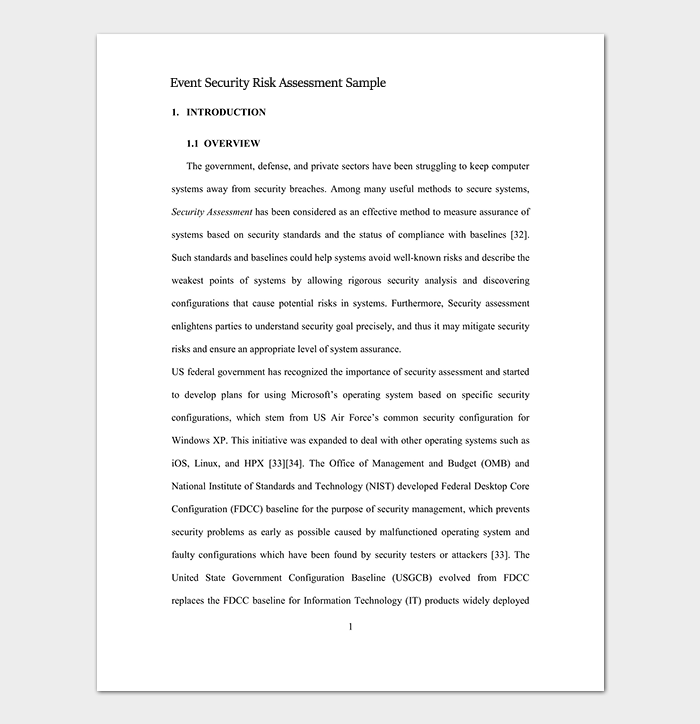
Event Security Risk Assessment
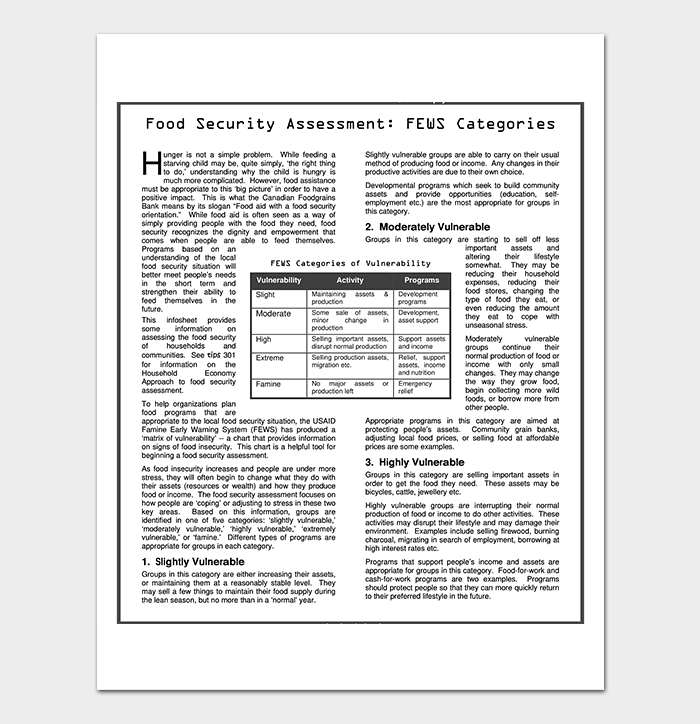
Food Security Assessment
Hotel Security Assessment Template

Sample Risk Assessment for Physical Security
An effective executive summary of a security assessment report should provide a concise overview of the risk levels for key areas, while considering the potential impact of future incidents on these levels. To be useful for busy top executives, the summary should be brief and to-the-point, containing only the essential information needed to make informed decisions. By presenting the key findings and recommendations in a clear and concise manner, the executive summary can help stakeholders quickly understand the security posture of the organization and prioritize any necessary actions.

Security Risk Assessment (DOC)

Personal Security Risk Management

Neighborhood Security Risk Assessment

Information Security Assessment Template

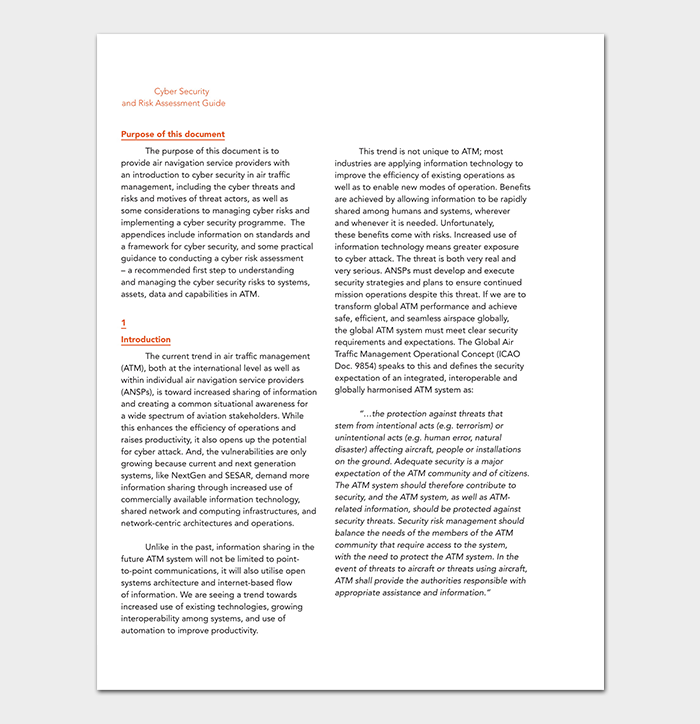
Cyber Security and Risk Assessment Template
A cyber security risk assessment report can be a valuable tool for identifying specific security gaps that may not be immediately obvious. By prompting you with targeted questions, the report can guide you in articulating your findings and help ensure that your assessment is thorough and comprehensive. This process can lead to a more detailed and accurate understanding of your organization’s cyber security posture, enabling you to prioritize actions and allocate resources to address any vulnerabilities.
Security Risk Assessment Checklist Template

Physical Security Risk Assessment Template

Security Risk Assessment Template in Excel
If you prefer working with numeric values, a security risk assessment template in Excel can be a helpful resource. This type of template provides a structured approach to identifying and evaluating potential security risks, allowing you to analyze and prioritize your findings using quantitative data. By organizing your assessment in Excel, you can easily sort and filter your results, as well as create charts and graphs to help visualize the data.

Commercial Security Risk Assessment Format

When Security Risk Assessment Template is Needed?
Conducting a security risk assessment is an important process for any organization that wants to safeguard its operations and protect against potential threats. However, knowing when to conduct a security risk assessment can be challenging. Here are some situations where a security risk assessment template is important:
- Initial Security Implementation: When setting up a new organization or introducing an information security program, a Security Risk Assessment Template is invaluable for identifying and addressing initial security risks and establishing a baseline security posture.
- Major Infrastructure Changes: During significant changes to an organization’s IT infrastructure, such as system upgrades, cloud migration, or network expansion, reassessing security risks using a template helps in identifying new vulnerabilities and ensuring a smooth transition.
- Regulatory Compliance: Whenever there are updates or changes to relevant industry regulations, standards, or legal requirements, a Security Risk Assessment Template should be used to assess and validate the organization’s ongoing compliance.
- Post-Incident Review: In the aftermath of a security incident or breach, using a Security Risk Assessment Template can help identify the root causes, evaluate the effectiveness of current security measures, and prevent similar incidents from occurring in the future.
- Mergers and Acquisitions: During mergers and acquisitions, a comprehensive risk assessment is critical to identify potential security risks within the combined organization and address them accordingly.
- Introduction of New Technologies: When adopting new technologies or applications, a Security Risk Assessment Template can help organizations identify and mitigate potential risks associated with the implementation and integration of these technologies into existing systems.
- Periodic Reviews: Organizations should conduct periodic security risk assessments using a template to stay informed about the evolving threat landscape, ensuring their security measures remain effective and up-to-date.
- Third-Party Vendor Assessments: When engaging with third-party vendors or suppliers, a Security Risk Assessment Template can be used to evaluate their security practices and potential risks associated with sharing sensitive information or granting access to the organization’s systems.
Essential Elements of Security Risk Assessment Template
A security risk assessment template is a pre-built framework that provides a systematic approach to identify, evaluate, and prioritize potential security risks. To ensure that the assessment is thorough and effective, it’s important to include essential elements in the template. Here are some of the essential elements of a security risk assessment template:
- Asset Identification: A clear and concise inventory of all critical information assets, including hardware, software, data, and infrastructure, as well as their respective classification based on sensitivity and importance to the organization.
- Threat Identification: A list of potential threat sources and actors, such as hackers, insiders, competitors, or natural disasters, that could exploit vulnerabilities and compromise the organization’s security.
- Vulnerability Assessment: An evaluation of the organization’s security weaknesses and gaps, including outdated software, unpatched systems, inadequate policies, or insufficient access controls, which could be exploited by threat actors.
- Risk Analysis: A systematic method for estimating the likelihood and impact of identified threats and vulnerabilities, taking into account factors such as the organization’s size, industry, and geographical location.
- Risk Prioritization: A process for ranking identified risks based on their potential impact on the organization’s operations and reputation, allowing for the allocation of resources and implementation of security measures in a strategic manner.
- Risk Mitigation Strategies: A list of recommended actions and controls designed to reduce, transfer, or accept identified risks, along with an estimation of their effectiveness and the resources required for implementation.
- Monitoring and Review: A process for regularly monitoring and reviewing the organization’s security posture, risk landscape, and the effectiveness of implemented risk mitigation strategies, ensuring continuous improvement and proactive risk management.
- Roles and Responsibilities: A clear definition of the roles and responsibilities of key stakeholders involved in the risk assessment process, such as IT teams, senior management, and external partners, fostering accountability and collaboration.
- Documentation and Reporting: A structured format for documenting the findings and results of the risk assessment process, facilitating clear communication and decision-making among stakeholders.
- Compliance and Regulatory Alignment: An overview of the relevant industry standards, regulations, and legal requirements that the organization must adhere to, ensuring that the risk assessment process aligns with these guidelines.
How to Use Security Risk Assessment Template?
A security risk assessment template is an invaluable tool for organizations looking to proactively manage their security risks. However, simply having a template is not enough; it’s essential to know how to use it effectively. Here are some tips on how to use a security risk assessment template:
- Select or Customize a Template: Choose a suitable template based on your organization’s specific needs, industry, and regulatory requirements, or customize an existing template to better align with your unique security objectives and context.
- Assemble a Cross-Functional Team: Form a team comprising members with diverse skill sets and expertise, including IT security, compliance, business operations, and senior management, to ensure a holistic and collaborative approach to the risk assessment process.
- Identify and Classify Assets: Using the template, create an inventory of all critical information assets, and classify them based on their sensitivity, importance, and potential impact on the organization in the event of a security breach.
- Identify Threats and Vulnerabilities: Enumerate potential threats and vulnerabilities that could impact your organization’s security, taking into account factors such as industry trends, historical incidents, and emerging technologies.
- Conduct a Risk Analysis: Estimate the likelihood and impact of identified threats and vulnerabilities using the criteria and guidelines provided in the template. This step is crucial in determining the overall risk level and prioritizing mitigation efforts.
- Develop and Implement Risk Mitigation Strategies: Based on the risk analysis results, design and implement appropriate risk mitigation strategies, such as enhancing security controls, updating policies, or increasing employee training, to address the identified risks.
- Monitor and Review: Regularly monitor and review the effectiveness of implemented risk mitigation strategies, as well as the evolving risk landscape, updating the template and risk assessment process as needed to ensure continuous improvement and proactive risk management.
- Document and Communicate Findings: Use the template’s documentation and reporting format to record the findings and results of the risk assessment process. Share this information with relevant stakeholders to support informed decision-making and foster a culture of security awareness within the organization.
- Maintain Compliance: Ensure that the risk assessment process aligns with relevant industry standards, regulations, and legal requirements, using the template as a guide to verify ongoing compliance and meet audit requirements.
Security Risk Assessment Template
Organization Details
- Organization Name: [(Organization name)]
- Date: [(Date of assessment)]
- Assessment Team: [(List team members)]
- Industry: [(Industry type)]
Asset Identification
- Asset Name: [(Name of the asset)]
- Asset Type: [(Hardware, Software, Data, Infrastructure)]
- Asset Owner: [(Individual or department responsible for the asset)]
- Asset Location: [(Physical or virtual location of the asset)]
- Asset Classification: [(Sensitivity level and importance to the organization)]
Threat Identification
- Threat Name: [(Name or description of the threat)]
- Threat Source: [(Internal, External, Natural, Human, Technical)]
- Threat Actor: [(Individual, group, or event that could exploit vulnerabilities)]
Vulnerability Assessment
- Vulnerability Name: [(Name or description of the vulnerability)]
- Affected Assets: [(List of assets affected by the vulnerability)]
- Vulnerability Severity: [(Low, Medium, High, Critical)]
Risk Analysis
- Likelihood: [(Low, Medium, High, based on the probability of the threat exploiting the vulnerability)]
- Impact: [(Low, Medium, High, based on the potential damage or consequences)]
- Risk Level: [(Low, Medium, High, based on the combination of likelihood and impact)]
Risk Prioritization
- Risk Ranking: [(Rank the identified risks based on their risk level)]
- Rationale: [(Explanation for the ranking, based on factors such as potential impact, likelihood, and the organization’s context)]
Risk Mitigation Strategies
- Strategy Name: [(Name or description of the mitigation strategy)]
- Risk Addressed: [(Risk being addressed by the strategy)]
- Implementation Cost: [(Estimated cost of implementing the strategy)]
- Strategy Effectiveness: [(Low, Medium, High, based on the estimated reduction in risk)]
Monitoring and Review
- Monitoring Frequency: [(How often the risk assessment process should be reviewed and updated)]
- Monitoring Method: [(Description of the method used to monitor the effectiveness of implemented mitigation strategies)]
- Review Trigger: [(Events or situations that may warrant a review of the risk assessment, such as changes in the organization’s infrastructure, regulations, or the emergence of new threats)]
Roles and Responsibilities
- Role: [(Title or description of the role)]
- Responsibilities: [(List of responsibilities associated with the role)]
- Name: [(Name of the individual or department assigned to the role)]
Documentation and Reporting
- Summary of Findings: [(Brief overview of the key findings from the risk assessment process)]
- Recommendations: [(List of suggested actions or improvements based on the findings)]
- Report Distribution: [(List of stakeholders who should receive the report)]
Compliance and Regulatory Alignment
- Relevant Standards: [(List of applicable industry standards and best practices)]
- Regulatory Requirements: [(List of relevant regulations and legal requirements)]
- Compliance Status: [(Description of the organization’s compliance with the identified standards and regulations)]
Note: This template is intended as a starting point and should be adapted to the specific needs and context of each organization. Regularly review and update the template to ensure it remains relevant and effective in addressing the unique security challenges faced by the organization.
Tips for Using Security Risk Assessment Template
Using a security risk assessment template is an effective way for organizations to identify and mitigate potential security risks. However, simply having a template is not enough; it’s important to know how to use it effectively. Here are some tips for using a security risk assessment template:
- Understand Your Organization’s Context: Before using a template, ensure that you have a deep understanding of your organization’s specific needs, objectives, and risk appetite. This understanding will guide you in selecting or customizing a template that aligns with your unique requirements and security goals.
- Keep the Template Up-to-Date: Regularly review and update the template to reflect changes in the organization’s infrastructure, industry regulations, emerging technologies, and the evolving threat landscape. This will ensure the template remains relevant and effective in addressing current security challenges.
- Involve Key Stakeholders: Engage representatives from various departments, such as IT, compliance, and business operations, in the risk assessment process. Their diverse perspectives and expertise will contribute to a more comprehensive and accurate understanding of the organization’s risk landscape.
- Adopt a Layered Approach: Recognize that no single security measure can provide complete protection against all risks. Use the template to identify and implement a combination of preventive, detective, and corrective controls that work together to provide a robust defense-in-depth strategy.
- Prioritize Risk Mitigation Efforts: Focus on addressing the most significant risks first, based on their potential impact on the organization’s operations and reputation. This approach ensures the most effective use of limited resources and helps to achieve maximum return on investment in security measures.
- Document and Communicate Findings: Clearly document the findings and results of the risk assessment process, using the template’s reporting format. Share this information with relevant stakeholders to support informed decision-making and foster a culture of security awareness within the organization.
- Implement Continuous Monitoring and Review: Regularly monitor and review the effectiveness of implemented risk mitigation strategies and the evolving risk landscape. Update the template and risk assessment process as needed to ensure continuous improvement and proactive risk management.
- Benchmark Against Industry Standards: Use the template to align your risk assessment process with industry standards and best practices, such as ISO/IEC 27001, NIST SP 800-30, or FAIR. This will not only help ensure a comprehensive risk assessment but also facilitate compliance with relevant regulations.
FAQs
Yes, a security risk assessment template can be customized to suit the specific needs of any type of organization, regardless of its size or industry.
The frequency of security risk assessments depends on several factors, including the organization’s industry, regulatory requirements, and risk profile. In general, organizations should conduct security risk assessments at least annually, or more frequently if significant changes occur in the organization’s operations.
In many cases, organizations may benefit from involving external experts, such as security consultants or auditors, to provide an objective perspective and ensure that the assessment is thorough and comprehensive. However, this is not always necessary, and organizations can use internal resources to conduct the assessment if they have the necessary expertise.
Yes, many industries are subject to regulatory requirements that mandate regular security risk assessments. Using a security risk assessment template can help organizations comply with these regulations and demonstrate their commitment to security.
Yes, many cyber insurance providers require organizations to conduct regular security risk assessments as a condition of coverage. Using a security risk assessment template can help organizations meet these requirements and ensure that they have adequate insurance coverage in place.
Yes, even organizations with existing security controls in place can benefit from conducting regular security risk assessments. These assessments can help identify new threats and vulnerabilities, as well as ensure that existing controls are effective and up-to-date.
The time required to conduct a security risk assessment using the template depends on the size and complexity of the organization, as well as the scope of the assessment. However, in general, assessments can take several weeks to several months to complete.
Conclusion
In today’s complex and rapidly-evolving security landscape, conducting a security risk assessment is an essential process for organizations looking to safeguard their operations and protect against potential threats. A security risk assessment template provides a structured, standardized, and objective approach to risk management, helping organizations to identify and prioritize potential security risks and develop effective risk mitigation strategies. By customizing the template to suit the specific needs of the organization, involving relevant stakeholders, and following best practices for conducting assessments, organizations can proactively manage their security risks and ensure that they remain resilient in the face of evolving security threats.