A quotation letter is a formal document that states your price for specific goods or services and the terms attached to that price. It is used when someone needs pricing in writing, not just a quick number, so there is less room for misunderstandings about what the price covers.
The most important part of a quotation letter is that it connects pricing to scope. That scope might be a list of items with quantities and unit prices, a defined set of services, or a project with labor, materials, and a timeline. When the scope is written clearly, the buyer can evaluate the quote without guessing what is included, and you can avoid disputes caused by assumptions.
A quotation letter also creates a record of what you quoted on a specific date, under specific conditions, for a limited period of time. This matters because pricing and timelines can change when requirements change, materials become unavailable, or access and site conditions differ from what was expected. Adding a validity period, basic assumptions, and a simple approach for changes keeps the quote aligned with real conditions and makes revisions easier if the buyer requests updates.
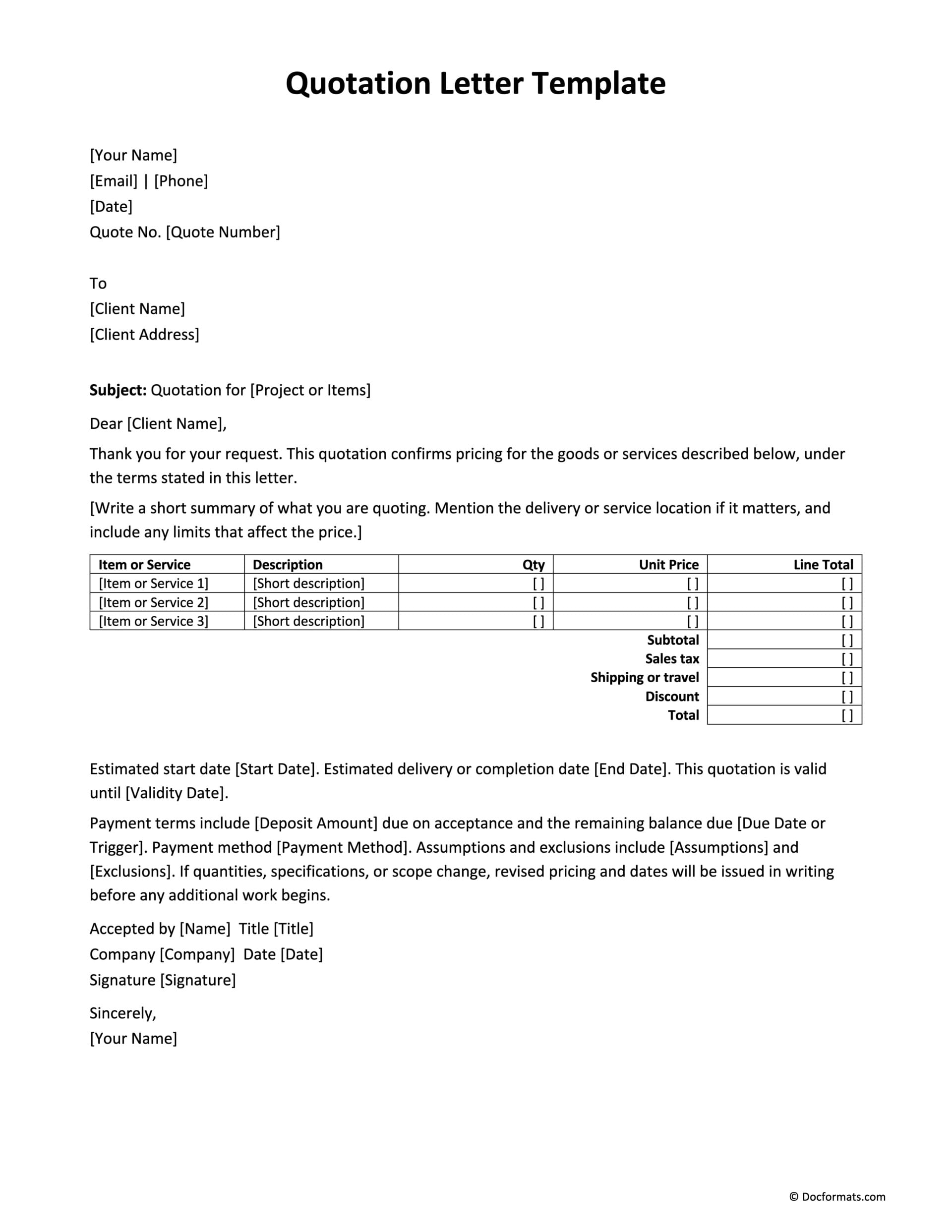
Quotation Letter Template
RFQ Letter Template
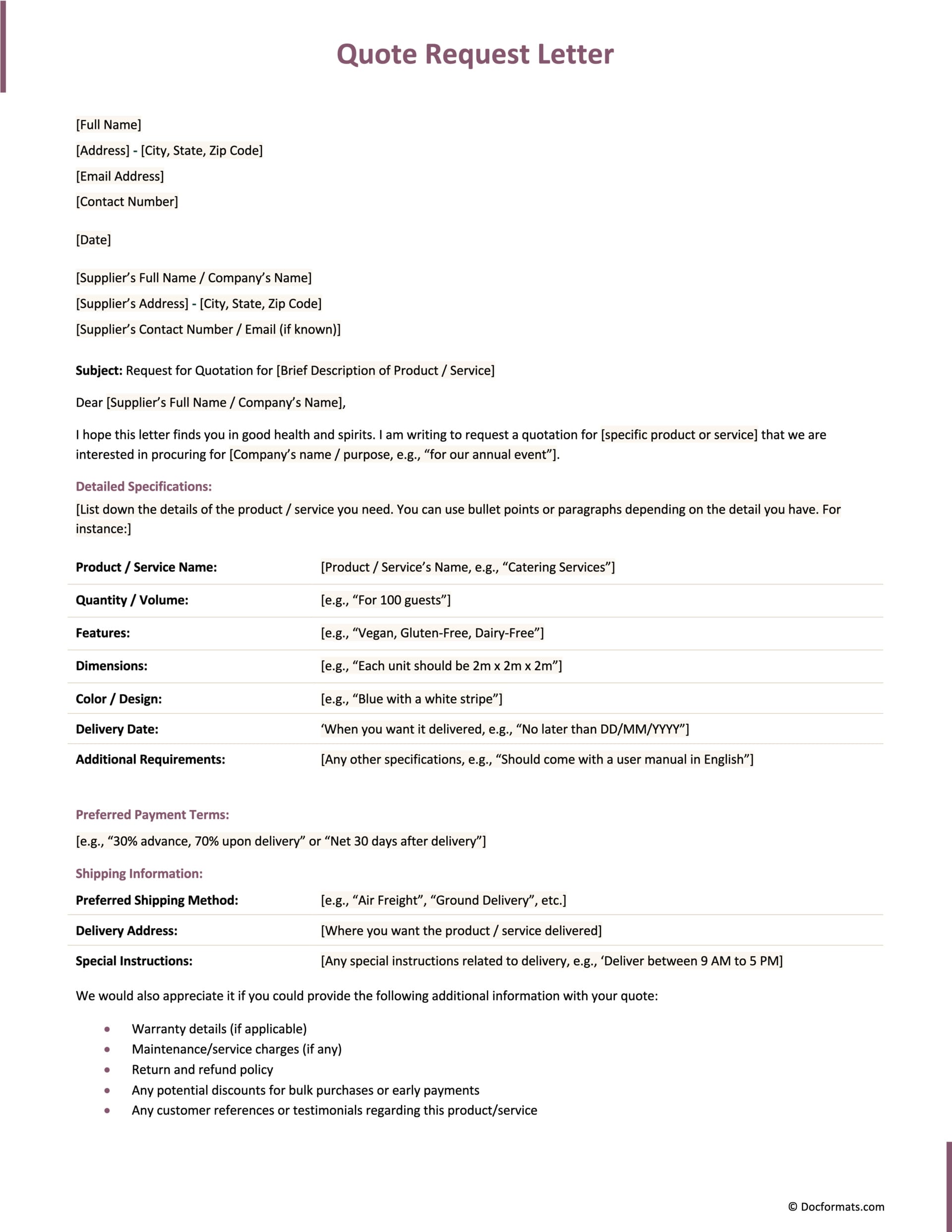
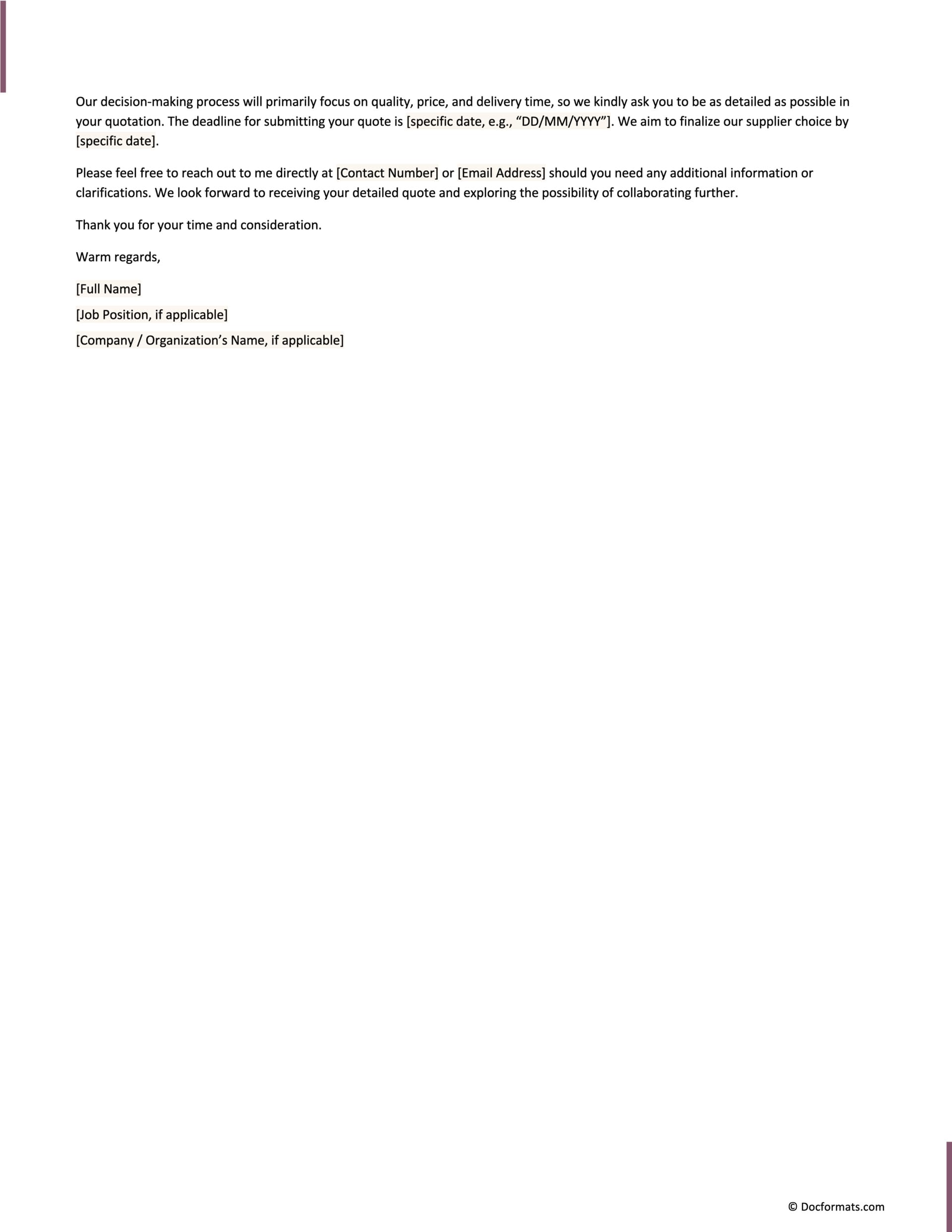
What Is a Quotation Letter?
A quotation letter is a formal document that states pricing for a defined set of goods or services, along with the terms tied to that pricing. It is meant to be read and approved without extra explanation, so the buyer can see what you are pricing, what is included, what is not included, and what conditions apply.
A quotation letter sits in the middle of a typical buying process. It is not a marketing document and it is not a bill. It is a written statement that connects scope to money and sets expectations before work starts or items ship. In many real-world situations, the wording in a quote can influence how the buyer treats it, especially when the quote says the price will be held open for a stated time.
Important:
If you sell goods and you promise to hold a price open in a signed writing, that promise can carry legal weight under UCC firm offer rules in many jurisdictions.
How to Write a Quotation Letter (Step-by-Step)
A quotation letter reads best when it moves in a predictable order. Start by identifying the quote and the parties, then confirm what is being priced, then show pricing in a way that can be checked line by line, and finish with the terms required for approval. The steps below follow that flow so the buyer sees the most decision-critical information early, while still having enough detail to prevent disputes later.
Confirm what the buyer requested before you write numbers
Begin by confirming what you are pricing in practical terms. For goods, that usually means the product name, model, size, quantity, and any included accessories or services such as setup or training. For services, it means the deliverables, the location, and any limits such as a fixed number of hours, a fixed number of revisions, or a defined area of work.
If the request was discussed across calls and messages, reduce it to one sentence you can stand behind. This step prevents the most common problem in quoting, which is pricing the version of the request you imagined rather than the version the buyer expected.
Start with a minimal sender block
Begin with your name, then one contact line, then the date. This keeps the header short while still giving the buyer a way to reply and file the document correctly. If you represent a business, you can put the business name on the first line and your name on the next line, but keep it brief.
Example
Stuart Martin
[email protected] | (212) 555-0147
March 14, 2094
Add the quote number on its own line
Place the quote number near the top so it becomes the reference point for revisions, approvals, and later questions. Keep the format consistent across all quotes.
Example
Quote No. Q-2094-0314
Write the recipient block the way mail is addressed
Use the recipient block so the letter can be printed, forwarded, or saved without losing context. Include the person’s name and the address. If the job location differs from the billing address, you can mention the job location later in the opening paragraph rather than adding extra header lines.
Example
To
Kate Phillips
860 Washington St
New York, NY 10998
Add a subject line that names the quote
The subject line should be specific enough that someone who was not part of the conversation still understands what the quote is for. Keep it short and concrete.
Example
Subject: Quotation for Office Reception Area Painting
Use a greeting that matches the name in the recipient block
Use the same name you used in the recipient block. If you do not have a contact name, use a neutral line such as “Dear Hiring Manager” style wording for business settings, but a named greeting is better when you have it.
Example
Dear Kate Phillips,
Write the opening paragraph that anchors the quote
In the first paragraph, confirm that the buyer requested pricing in writing and state what the quote covers. Mention the service or delivery location if it affects pricing. If there is any boundary that changes cost, state it here so it is seen before the numbers.
Example
Thank you for requesting pricing in writing. This quotation confirms pricing for repainting the office reception area at 860 Washington St, New York, NY 10998.
Add a scope paragraph that sets boundaries before the table
This paragraph is where you prevent assumptions. Write what is included in plain language, then state what is not included if it is a common point of confusion for this kind of work. Keep it to a few sentences so it stays readable.
Example
Work includes surface preparation, minor patching of small holes, priming where needed, and two coats of interior wall paint for the reception walls. Floors and nearby fixtures will be protected, followed by standard cleanup after completion. Ceiling painting and trim painting are not included.
Insert the pricing table with line items that can be checked
Use a table so the buyer can verify each charge. Line items should map to real parts of the job or order. Keep descriptions short but specific. If a line is optional, label it as optional in the description so it cannot be confused with required work.
Example
Item or Service Description Qty Unit Price Line Total Labor Prep and paint, 2 painters, 2 days 1 $2,200 $2,200 Materials Primer, paint, tape, plastic, patch compound 1 $380 $380 Cleanup Protection removal and final cleanup 1 $120 $120 Subtotal $2,700 Sales tax $0 Shipping or travel $0 Discount $0 Total $2,700
Show totals in a predictable order right under the table
Right after the line items, show the totals so the buyer can confirm the math without scanning. Keep the order consistent from quote to quote.
- Subtotal The sum of all line totals.
- Sales tax Use a separate line when it applies to the transaction.
- Shipping or travel Keep it visible when it is a real cost.
- Discount List it as its own line so it is easy to verify.
- Total The final amount for approval.
Example
Subtotal $2,700 Sales tax $0 Shipping or travel $0 Discount $0 Total $2,700
Write timing in plain, schedulable language
After pricing, state timing in a way the buyer can plan around. For services, include an estimated start and completion date. For goods, include lead time and delivery timing. Add one realistic dependency if it matters, such as access hours or approvals.
Example
Estimated start date March 28, 2094. Estimated completion March 29, 2094, assuming access is available from 9:00 a.m. to 5:00 p.m. on both days.
Add validity and payment terms as short paragraphs
Validity should be one sentence with a date. Payment terms should state what is due, when it is due, and what triggers the remaining balance. Keep these as separate paragraphs so they do not get buried.
Example
This quotation is valid until April 13, 2094.
A deposit of $1,000 is due on acceptance to reserve the work dates. The remaining balance of $1,700 is due upon completion, payable by check or bank transfer.
Add assumptions, exclusions, and a change rule without legal-heavy wording
Assumptions and exclusions prevent scope creep. Keep them short, then be specific. After that, add one sentence that explains what happens when scope or quantities change.
Example
This price assumes walls only need minor patching. Wallpaper removal, moving large furniture, and repairs beyond minor patching are not included. If additional repairs are needed after preparation begins, revised pricing will be issued in writing before work continues.
End with acceptance and a minimal closing
Acceptance should be easy to sign and return. Place it near the end so it is not separated from the terms. After acceptance, use a simple closing and your name.
Example
If you approve this quotation, please sign below and return a copy by email.
Sincerely,
Stuart Martin
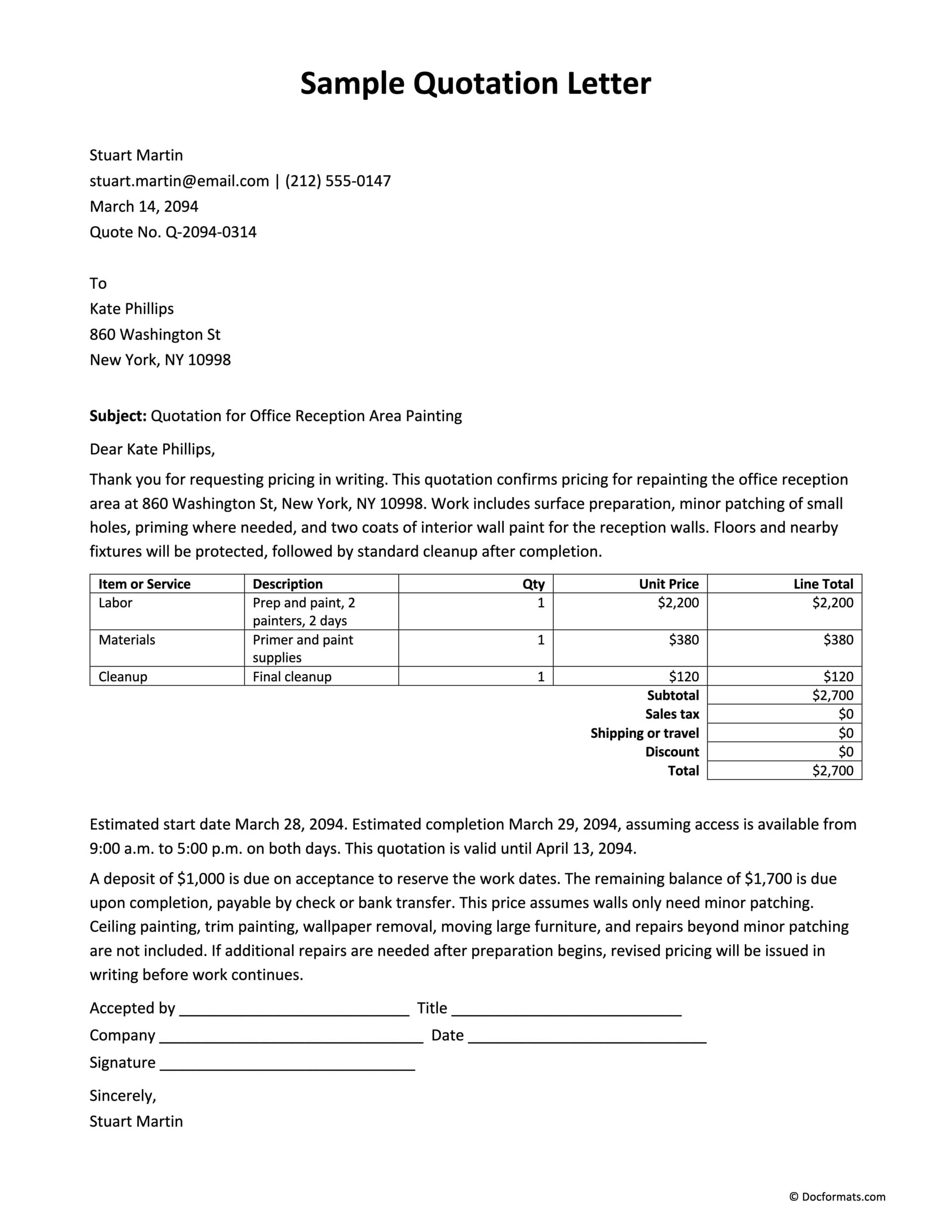
Sample Quotation Letter
Example
April 02, 2094
Quote No. Q-2094-0402
To
Kate Phillips
860 Washington St
New York, NY 10998
Subject: Quotation for Website Content Writing and Editing Services
Dear Kate Phillips,
Thank you for requesting pricing in writing. This quotation confirms pricing for content writing and editing services for your website project.
The work includes writing three service pages and editing two existing pages for grammar, flow, and consistency. Each new page will be written based on your notes and any reference materials you share. One revision round per page is included. Additional revision rounds, new pages beyond the five listed here, and SEO research beyond the keywords you provide are not included unless added as separate line items.
| Item or Service | Description | Qty | Unit Price | Line Total |
|---|---|---|---|---|
| New page writing | Service page drafting, up to 900 words each | 3 | $260 | $780 |
| Editing | Editing and rewrite of existing pages, up to 900 words each | 2 | $140 | $280 |
| Formatting | Basic formatting for headings and readability | 1 | $60 | $60 |
| Subtotal | $1,120 | |||
| Sales tax | $0 | |||
| Shipping or travel | $0 | |||
| Discount | $0 | |||
| Total | $1,120 |
Work can begin on April 08, 2094, assuming the content brief and reference notes are provided by April 06, 2094. Draft delivery is estimated within seven business days from the start date. If review feedback is delayed, the completion date may shift accordingly.
This quotation is valid until May 02, 2094.
A deposit of $560 is due upon acceptance to begin work. The remaining balance of $560 is due after delivery of the first drafts, payable by check or bank transfer.
This quotation assumes you will provide the brand name spelling, preferred tone, and any required compliance wording before drafting begins. Stock images, graphic design, publishing directly into your website, and rewriting based on changes to scope after drafting begins are not included. If additional pages or revision rounds are requested, revised pricing and timing will be provided in writing before that work proceeds.
If you approve this quotation, please sign below and return a copy by email.
Accepted by
Kate Phillips Title Operations Manager
Phillips Office Solutions LLC Date April 03, 2094
Kate Phillips
Sincerely,
Stuart Martin
When You Should Use a Quotation Letter
A quotation letter is the right choice when pricing is tied to defined scope and the buyer wants it in writing for review or approval. It is also useful when you want boundaries around what is included, because boundaries are what prevent price disputes later.
Use a quotation letter when the buyer is comparing vendors and you want your pricing to be understood in context, not as a single number. It is also a strong fit when the project has common add-ons that can expand scope, such as repairs discovered after work begins, additional quantities added late, or changes requested after design review.
A quotation letter also makes sense when timelines matter. When you include timing and validity, the buyer can plan around availability and you can avoid being pulled into an old quote that no longer matches current conditions.
Quotation Letter vs Estimate vs Proposal vs Invoice vs Purchase Order
These documents sound similar because they often appear in the same conversation, but they serve different purposes. Understanding the difference matters because the buyer will treat each document differently during approval and payment.
A quotation letter states pricing tied to defined scope and terms before work starts or goods ship. An estimate is used when scope is still uncertain and the price can move as details become known. A proposal often explains the plan, methods, and reasoning, then attaches pricing, so the buyer sees not only the number but also how you intend to deliver the result.
An invoice is issued after delivery or completion as a request for payment, while a quote is issued before. This difference in timing is one reason buyers treat invoices as payable documents and quotes as review documents.
A purchase order is generally issued by the buyer to authorize a purchase and confirm what they intend to buy. If a purchase order includes terms that differ from your quotation letter, treat that difference as something to resolve before work begins, because mismatched terms create payment and delivery disputes later.
Pricing Details That Prevent Disputes
Pricing disputes usually come from one of three problems. The scope was not defined tightly enough, extra charges were implied rather than written, or the totals were hard to verify. You can reduce all three by writing pricing so the buyer can check it like a checklist.
Line items are one of the most effective dispute reducers because each cost has a visible reason. Separate charges that commonly surprise buyers, such as shipping, travel, setup, rush timing, or disposal. If you apply sales tax, show it as its own line or explain how it will be calculated based on the delivery or service location. Sales tax rates can vary by state and local jurisdiction, so a single generic rate can be wrong even within the same city.
Pro Tip:
If you bill services by time, state the billing unit in a sentence, such as billing in hourly increments with a minimum. This prevents disagreements about partial time.
Terms and Conditions That Matter Most in a Quote Letter
Terms and conditions do not have to be long to be effective. The goal is to address the terms that most often change the buyer’s decision or cause conflict later. These usually relate to validity, payment timing, delivery timing, and changes.
Validity terms state how long pricing remains available. Payment terms state deposits, balance timing, and accepted payment methods. Delivery or completion terms state what timing you are quoting and what events commonly shift that timing.
Change terms explain what happens when scope changes after the quote is issued. This is where many disputes start, because buyers add work in conversation and assume the original price remains. A short change sentence creates a written rule that protects both sides.
Consideration:
If you quote goods and use “held open” language, UCC firm offer concepts can affect revocability when the quote is a signed writing that gives assurance the offer will be held open.
How to Send the Quotation Letter
Sending a quotation letter is part of keeping the message intact as it moves through approvals. Many quotes get forwarded to finance, procurement, and managers, so the document should look the same no matter who opens it.
Send the quotation letter as a PDF after review so numbers and wording do not shift during forwarding. Use the quote number in your email subject line so the thread stays searchable. In the email body, restate the total and the validity date in one sentence so the buyer sees the two decision-critical details without hunting through attachments.
Pro Tip:
If the buyer tends to respond slowly, include one sentence that asks them to confirm if they want a revised quote after expiry. It reduces confusion when the validity date passes.
How to Revise a Quote After Client Feedback
Revisions are normal, but revisions become messy when multiple versions circulate without a reliable label. A clean revision process keeps one active version and makes changes easy to understand.
Start by restating what changed in one short paragraph, then revise scope wording first, then revise pricing. Update timing if the change affects delivery or completion dates. Update the validity date so the revised quote does not inherit an old expiry that no longer fits the timeline.
When you send the revision, refer only to the revised version in your email and ask the buyer to discard older copies. This small step reduces the chance that a buyer approves the wrong version by mistake.
Common Quotation Letter Mistakes To Avoid
Quotation problems are usually avoidable, but they repeat because small omissions create big assumptions. The mistakes below show where quotes most often go wrong and why each one leads to disputes or delays.
- Missing validity period leads to old pricing being treated as still active, even when costs or lead times changed.
- Vague scope wording causes the buyer to assume extra items are included, especially for services where boundaries are not obvious.
- Hidden charges such as shipping, travel, or rush work create conflict when they appear after the buyer thought the total was final.
- Math that does not reconcile undermines confidence immediately. Buyers often pause approval until they can verify numbers, or they request a new quote even if the pricing is fine.
- No exclusions causes scope creep, because the buyer has no written list of what the quote does not cover.
- No written change rule leads to informal additions that turn into pricing arguments after the work is done.
- Unclear acceptance method slows approval, because the buyer is unsure if they should sign, reply by email, or issue a purchase order.
FAQs
It depends on wording, what is being sold, and how acceptance happens. A quotation letter with definite terms that is accepted can form a contract in many situations. For goods, UCC firm offer rules describe when a merchant’s signed writing that gives assurance an offer will be held open is not revocable during the time stated, subject to limits in the section.
Many businesses use a window such as one to four weeks, but the best validity period depends on how quickly pricing or availability can change and how long the buyer’s approval cycle tends to take. If costs move frequently, a shorter validity period is more realistic. If approvals routinely take longer, a longer validity period may be reasonable, but it should still be written so the quote does not remain open indefinitely.
Often, yes, because it makes the total easier to audit and it reduces surprises. Sales tax is often set at state and local levels and can vary by location, so showing tax as its own line or stating how it will be calculated based on the delivery or service location prevents confusion.
If shipping or travel costs are real and variable, listing them separately reduces disputes and gives the buyer a visible reason for the charge. If you bundle these costs into unit pricing, say that they are included so the buyer does not assume they were forgotten.
A signature is common for higher-value quotes or procurement workflows, but some buyers approve by written email confirmation or by issuing a purchase order. The best practice is to state what you consider acceptance in the quotation letter so approval does not stall due to uncertainty.
Restate the change request in writing, then issue a revised quote that updates scope, pricing, timing, and validity. This keeps both sides aligned on what changed and prevents older versions from being treated as the current agreement.