A questionnaire template is a pre-constructed tool consisting of systematically arranged questions intended to elicit specific responses from individuals. Serving as the cornerstone for consistent and effective data collection, these templates enable researchers in various fields—including market research, education, and public health—to facilitate insightful analysis and draw meaningful conclusions.
The journey from creating a questionnaire template to receiving actionable data, however, is a complex one. It requires strategic question formulation, a keen understanding of your audience’s comprehension levels, stringent data privacy considerations, and effective strategies to motivate respondent participation. To assist you in this intricate process, we’ve assembled a selection of carefully designed templates and practical examples. These resources illuminate the path to crafting impactful questionnaires, helping you develop tools that resonate with your audience and facilitate the extraction of valuable and precise information.
Questionnaire Templates


How to Make a Good Questionnaire
The following guidelines will prove beneficial as you create your own engaging questionnaire.
- Embrace Simplicity in Your Questions: Avoid the common pitfall of complexity in questionnaire design. Complex questions often lead participants to abandon the questionnaire midway. Strive for clarity and simplicity in your questions for a higher completion rate.
- Determine the Necessary Information: Clearly identify the specific information you need before crafting your questions. Remember, the main goal of a questionnaire is to gather useful data, so every question should contribute meaningfully towards this objective.
- Make Personal Information Submission Optional: Given the potential discomfort around sharing personal details, making the provision of such data optional can mitigate participant drop-off.
- Provide a Motivation to Respond: Without an incentive, many people might not dedicate time to your questionnaire. Motivate participants by offering rewards such as gift cards or discounts.
- Prioritize Brevity: An ideal questionnaire takes no more than 5 minutes to complete. Short, easy-to-complete questionnaires often yield better response rates.
- Implement Simple Answering Techniques: Enhance your questionnaire’s user-friendliness by employing straightforward methods for answers, such as fill-ins or check boxes. This can greatly simplify the process for respondents, further improving completion rates.
Questionnaire Examples & Templates
We’ve curated a selection of questionnaire examples in Word and PDF formats to provide you with a comprehensive understanding of effective questionnaire design. These examples, which embody best practices in questionnaire creation, serve as valuable references when developing your own tool. Feel free to utilize these templates as a springboard for formulating a questionnaire tailored to your unique requirements.
Questionnaire Template 01

- MS Word
Questionnaire Template 02

- MS Word
Questionnaire Template 03

- MS Word
Questionnaire Template 04

- MS Word
Questionnaire Template 05

- MS Word
Questionnaire Template 06

- MS Word
Questionnaire Template 07

- MS Word
Questionnaire Template 08

- MS Word
Questionnaire Template 09

- MS Word
Questionnaire Template 10

- MS Word
Questionnaire Template 11

- MS Word
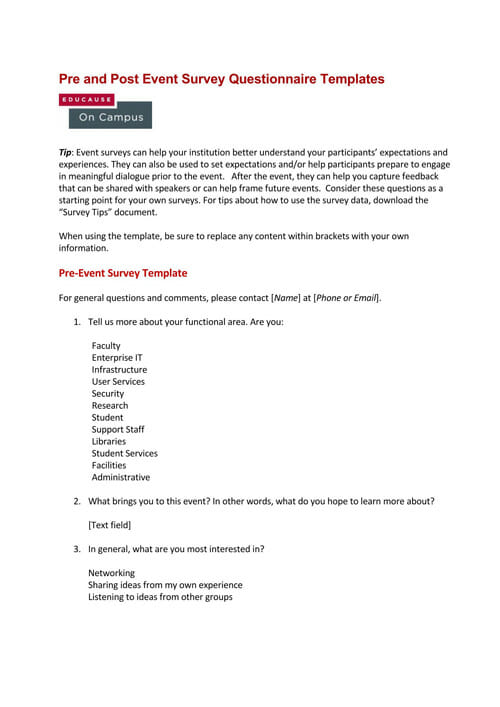
Questionnaire Template 12
- MS Word
Questionnaire Template 13

- MS Word
Questionnaire Template 14

- MS Word
Questionnaire Template 15

- MS Word
Questionnaire Template 16

- MS Word
Questionnaire Template 17

- MS Word
Questionnaire Template 18

- MS Word
Things to Avoid When Writing A Questionnaire
- Avoid Writing Leading Questions. When developing your survey, you will need to avoid leading questions. Leading questions will demand a specific response from the person taking the questionnaire. For example, “Which day is best for a company-wide safety meeting?” This prompts the respondent to pick a date without taking into consideration if a safety meeting is even warranted.
- Double Negatives Are A No No. Avoid questions that contain two negative words. This can confuse respondents who are taking your survey.
- Keep Lists of Choices Short. When you have a long list of choices at the end of a question, it can make it hard for respondents to decipher them all.
- Stay Away from Difficult Concepts. Try to avoid difficult concepts as they may be too complicated for some respondents to understand.
- Avoid Complicated Recall Questions. Over time people’s memories begin to fade, making them less reliable. Keep any recall questions as simple as possible.
Tips for Writing A Questionnaire
- Use Direct Questions: There is no reason to beat around the bush. Ask respondents direct questions and you will get the information you are looking for.
- Ask One Question at A Time: You don’t want to overwhelm your respondents by asking them more than one question at a time.
- Make Sure Each Question Is Useful: Take a look at each question on your survey and make sure they are useful to you.
- Take the Questionnaire: After you develop your questionnaire, take it for a test drive before sending it out.
FAQs
To prepare for a questionnaire, start out by defining your topics. Next, rank your topics from most important to least important. Finally, develop questions for each of your topics.
When writing a survey questionnaire, you will need to develop your topics of study. The questions you write for your topics need to be simple and to the point. Refrain from using over-complicated words. For the board, ideas make sure you break them down into several questions.
A questionnaire example is a very useful tool for collecting data from respondents for the purpose of survey analysis.
There are many advantages of a questionnaire. Fast results, useful data, and scalability are a few of those advantages. However, there are a few disadvantages that include interpretation issues, survey fatigue, and skipped questions.