A price increase letter is a formal document used to notify customers about changes in the pricing of goods or services. It serves as a clear and professional way to communicate the reasons behind the adjustment while maintaining trust and transparency with your audience. Whether you’re addressing a minor adjustment or a significant change, crafting a well-written price increase letter is essential to make sure that your message is received positively. Go through these templates and sample letters, which are written to help you communicate price adjustments confidently. They provide a strong foundation for composing an effective message that resonates with your audience.
Price Increase Letters
Price Increase Letter to Customers

Price Increase Letter

Rent Increase Letter

Sample Price Increase Letter
What Is a Price Increase Letter?
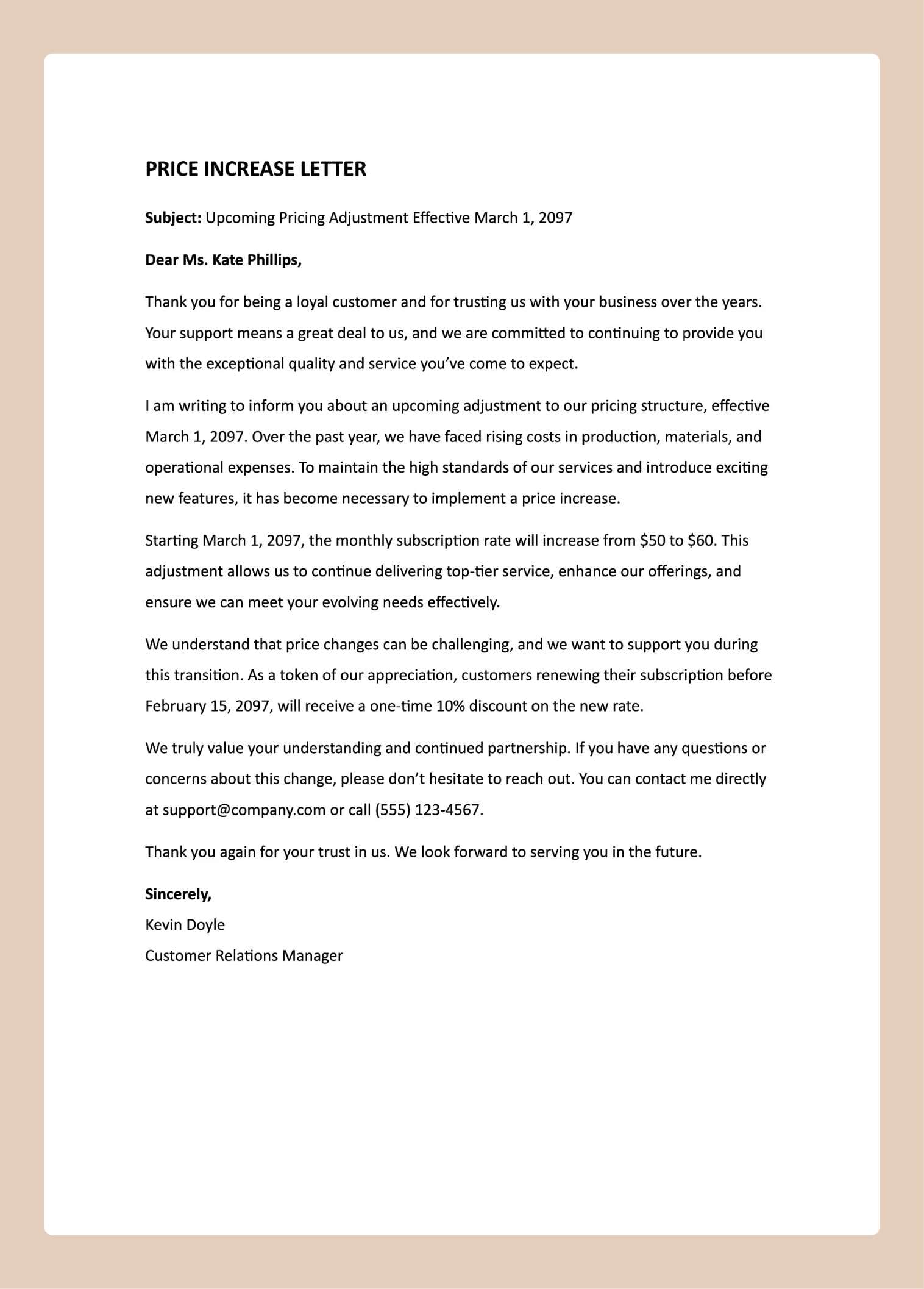
A price increase letter is a formal announcement businesses use to explain why they are raising prices on the services or goods they provide. Companies often adjust prices to offset rising costs or maintain quality, and this letter helps convey those reasons to clients. It typically includes details such as the percentage of the increase, the effective date, and any relevant context for the decision. This notice or letter can be delivered via email, post, or even as a public notice, depending on the audience and circumstances.
How to Write a Price Increase Letter
A price increase letter should be straightforward and informative. Here is a step-by-step guide to writing an effective letter, including examples for clarity.
- Step 1: Start with a Polite Greeting. Begin your letter with a friendly and professional greeting to set the right tone. Address your customer by name whenever possible.
Example: “Dear Mr. Stuart Martin,” “Dear Ms. Kate Phillips,” - Step 2: Announce the Price Increase. Immediately inform the recipient about the price change. Be direct and concise.
Example: “We are writing to inform you of an upcoming adjustment to our pricing, which will take effect on March 1, 2035.” - Step 3: Explain the Reason for the Increase. Provide a clear explanation of why the price adjustment is necessary. This helps customers understand and accept the change.
Example: “This adjustment reflects the rising costs of raw materials and operational expenses. We are committed to maintaining the quality of our products and services, and this change will ensure we can continue to deliver the value you expect.” - Step 4: Provide Specific Details About the Change. Be transparent about the new pricing structure and the effective date. Include details on what the increase applies to.
Example: “Starting March 1, 2025, the price of our standard subscription will increase by 10%, changing from $50 to $55 per month.” - Step 5: Express Gratitude and Appreciation. Thank your customers for their loyalty and support. Reassure them of your commitment to providing excellent products or services.
Example: “We sincerely appreciate your continued trust and support. Your satisfaction remains our top priority.” - Step 6: Offer Assistance or Flexibility. Show understanding for customers who may need additional support. Offer to address any questions or concerns.
Example: “If you have any questions about this change or need assistance, please don’t hesitate to reach out to our customer support team at [email protected] or call us at (555) 123-4567.” - Step 7: End on a Positive Note. Close the letter with a polite and optimistic message.
Example: “Thank you for your understanding and for choosing Excellence Corp. We look forward to continuing to serve you.”
Sample Price Increase Letter
Renee Cooper
Anderson Metal Fabrication
10028 East Meridian
Sherwood, MI 48776
November 14, 2039
Nathan Brooks
Pace Aircraft Repair
400 West Alliance Street
Sherwood, MI 48767
Subject: Notification of Price Adjustment
Dear Nathan Brooks,
We are writing to inform you of an upcoming adjustment to our pricing, effective January 1, 2040. The prices of all stainless and titanium fabricated parts will increase by 6%. This adjustment is necessary due to rising raw material costs, which have impacted our operations. We remain committed to providing high-quality products, and this change ensures that we can continue to meet your expectations without compromising on quality.
Any orders placed before December 31, 2039, will be honored at the current pricing. We encourage you to take advantage of this opportunity to place your orders before the adjustment takes effect.
We sincerely value your business and appreciate your understanding as we navigate these changes. If you have any questions or concerns about this adjustment, please feel free to contact us. Our sales and customer service teams are available to assist you and address any inquiries.
Thank you for your continued partnership with Anderson Metal Fabrication. We look forward to serving you in the future.
Best regards,
Renee Cooper
Anderson Metal Fabrication
Price Increase Letter Examples
#1

#2

#3
#4

#5

#6

#7

#8

#9

#10

#11

#12

#13

#14

#15

#16

#17

#18

#19

#20

#21

#22

#23

#24

#25

#26

#27

#28

#29

#30

Common Reasons to Increase the Prices
Here are common reasons businesses raise their prices:
- Selling to Retailers. Transitioning to selling through retailers often necessitates price adjustments. When products move through additional channels, such as retailers, the markup at each stage impacts the final cost. To sustain profitability, businesses must account for the retailer’s commission and operational efficiencies. Explaining this to your customers helps them understand how selling through retailers affects pricing. Additionally, if you’re entering new retail markets, price adjustments may align with industry norms and competitive benchmarks.
- Repositioning or Pivoting Your Business. As businesses grow, they often refine their focus, transitioning from low-cost offerings to higher-value services or products targeting a premium audience. Repositioning may involve improving product quality, expanding service options, or rebranding entirely. Raising prices reflects the added value customers receive and aligns with the new market positioning. Similarly, when demand surpasses operational capacity, increasing prices can help optimize the client base while maintaining or even improving revenue. This can also help phase out customers who do not align with your business goals or values, allowing you to prioritize clients who appreciate the higher quality or exclusivity of your offerings.
- Meeting Rising Costs. Inflation, increased labor expenses, and higher supply chain costs are unavoidable in most industries. To maintain healthy profit margins, businesses must periodically adjust their prices. Conducting regular market analysis and cost forecasting helps anticipate rising expenses and ensure sustainable pricing strategies. Highlighting these factors in your communication with customers—such as maintaining quality despite rising costs—can foster understanding and acceptance of the increase.
- Compliance with Market Dynamics. Market trends, competitor strategies, and regional pricing norms can all influence the need for price adjustments. For instance, if competitors are charging more for similar offerings, raising your prices can position your brand as a premium option and align with perceived value. Conversely, underpricing relative to the market can signal lower quality, which may not align with your brand’s goals.
- Enhancing Service or Product Offerings. Introducing new features, improving product quality, or expanding services often justifies price increases. Customers are typically more accepting of adjustments when they perceive added value. For example, integrating advanced technology, offering extended warranties, or improving delivery options are clear enhancements that warrant higher pricing. Outlining these improvements in your communication helps maintain transparency and build trust.
Another scenario where a price increase might be reasonable is when you introduce environmentally sustainable practices or materials into your production. Transitioning to eco-friendly methods often involves higher costs, which can justify a pricing adjustment. Communicating this change as part of your commitment to sustainability can also strengthen your brand image and appeal to customers who value environmentally responsible businesses.
Best Practices for Communicating a Price Increase
Communicating a price increase can be challenging, but following these best practices can help your message be well-received and minimize negative responses:
- Personalize and Segment Communication. Avoid sending a generic message to all customers. Instead, segment your audience based on their service plans or purchase history to make the message feel tailored and relevant. This can improve understanding and acceptance.
- Limit Price Increases to Once a Year. Customers are more likely to accept a price increase if it occurs infrequently. Consider raising prices annually, aligned with subscription cycles or other predictable timeframes, to reduce confusion and frustration.
- Provide Channels for Support. Give your customers a platform to raise concerns and receive the information they need. Provide a dedicated phone number or email address where they can ask questions. This personal connection helps prevent misunderstandings and reassures customers that their concerns are taken seriously.
- Include an FAQ Page. Link to an FAQ page in your communication to address follow-up queries, explain the reasons for the increase, and clarify any exceptions. This can reduce the volume of individual inquiries and provide quick answers to common questions.
- Strike a Balance Between Brevity and Clarity. Be concise but thorough. State the percentage or amount of the increase, the reason behind it, and the effective date. Avoid overloading the message with unnecessary details, as this can appear defensive. If relevant, assure customers that the price increase reflects your commitment to maintaining product quality or service standards.
- Provide Advance Notice. Inform customers well before the increase takes effect. This gives them time to adjust budgets or place orders at the current price, allowing for a smoother transition. Offering customers the opportunity to make purchases before the increase can also foster goodwill.
- Communicate Internally First. Make sure all team members, especially customer service and sales teams, are informed of the price increase. They should be prepared to address customer questions and explain the reasoning behind the decision.
- Leverage Multiple Communication Methods. Use the channels your customers engage with most frequently, such as email, phone calls, or direct mail. If you have branded templates for announcements, use them to maintain consistency. Additionally, direct communication, like phone calls or personalized emails, can be effective for long-term or high-value customers.
- Contact Customers Directly About Changes. Avoid surprising customers with sudden price increases. Proactively reach out to inform them and provide time to digest the information. Personalized contact helps maintain trust and reinforces the importance of their relationship with your business.
FAQs
A price increase letter is essential because it assists businesses in featuring a perfect relationship with their clients. It ensures that you maintain an ideal relationship with your clients.
There are a few reasons for raising your prices, such as:
• Aligning your prices with your competitors
• To correct previously undervalued services and goods
• To reduce the workload by emphasizing resources, more so on your chosen clients
• To enhance the quality of services or goods
• The rising 0verhead costs, like wages, transport, utilities as well as rent
When your industry experiences change, the services and resources needed to make your product hike or become more expensive. If this happens, you must increase your price to avoid losses and ensure that you maintain the quality of products your customers need. On the other hand, you can only increase your price when your clients are satisfied with the services and products you offer.
It should be a two-month notice. This gives your clients sufficient time to cancel their deals without going against your policies. It also allows them to adjust their budget effectively.
If you have a business, you must ensure that you build an excellent relationship with your customers using the price increase letters. This will automatically help you to create a good relationship with your clients. Below are a few reasons why businesses use the price increase letters:
• It shows your transparency in your business as well as its dealings.
• It enables your clients to make an informed decision whether they should continue engaging in business with you.
• It assists your customer in preparing for the financial challenge ahead.
Raising your prices will increase your sales because you will lose a good percentage of low margin and low-quality customers. Therefore, if you increase or maintain your margin, you will likely offer excellent products or services to your customers.
There are five pricing strategies, primarily:
• Bundle pricing
• Economy pricing
• Premium pricing
• Market penetration pricing
• Price skimming
Below are some tips that will help you send a price increase email:
• Avoid a lot of unnecessary information and go straight to the point
• Indicate value justification
• Avoid writing an essay
• Ensure you email your potential customers
• Personalize the mails
• Set a deadline
• Allow customers to reach you for inquiry and feedback via email or calls through your customer service
• Segment your recipients
Conclusion
At some point, every company faces the need to adjust the pricing of their goods or services. While this can be a challenging process, clear and proactive communication can make the transition smoother for both customers and employees. Circulating price increase letters internally before sharing them with customers allows your team to be well-prepared to address any questions or concerns. By providing advance notice, thoughtful explanations, and accessible support channels, businesses can maintain trust and reinforce their commitment to delivering quality, even during times of change.