
Many teachers and preschool caregivers find that preschool lesson plans help them stay organized and achieve objectives for the students, the parents, and the school administration. Parents want to be confident that their child’s development will progress while in preschool. The preschool management desire to maintain and improve its reputation as a preschool with parents and industry government monitoring agencies.
Preschool lesson plan templates can help teachers and caregivers achieve these results while helping to manage their challenges and achieve growth and learning objectives for the children. This post will discuss what preschool lesson plans are, how templates can be utilized, and how to prepare lesson plans for preschoolers.
What is a Preschool Lesson Plan?
Preschool lesson plans help the teacher and anyone replacing them organize the lesson, the topics covered, the materials needed for the lesson, and how the kids will participate. It establishes the objectives for the children, how the lesson will be presented to the children and how they will be assessed once the lesson is completed.
Replacement teachers can refer to the plan and follow the guide prepared to ensure that not a day is lost in the education of the children. An excellent lesson plan will include the following elements:
- Objectives
- Resources
- Processes
- Assessment methods
Teachers working with a well-defined lesson plan will have an easier time with the students since they will be involved and engaged and have a clear sense of the direction for the lesson every day.
What Is a Preschool Lesson Plan Template?
Templates can save preschool teachers a great deal of time, and preschool lesson plan templates are no different. Using a template guides the teacher in the preparation of the plan by helping them focus on the lesson they wish to give, organize, ensure materials are ready and evaluate the results of the lesson.
A preschool lesson plan template helps ensure that the lesson has structure and provides a routine for the students. When teams of teachers are involved, they can all work off the same template, ensuring consistency in the objectives, delivery, and evaluation of the students.
Trainee teachers also benefit from the use of lesson plan templates. The lesson plans can be detailed, including detailed instructions, questions, and the scheduled times for each activity. Fill-in or substitute teachers and assistants helping a teacher in a classroom setting also benefit when they are presented with a detailed lesson plan based on a structured template. Students also benefit since the trainee or fill-in teacher is working off a template completed by the primary teacher. In many cases, the lessons continue without interruption and meet the overall goals and objectives for the week or the term.
Templates can be used for a specific lesson, weekly goals, and objectives, monthly and yearly. Through developing both short and long-term lesson plans, goals, and objectives, the teacher will have a clear understanding of what they want to achieve throughout the year and where they need to be in the program throughout the year.
Preschool Lesson Plan Templates
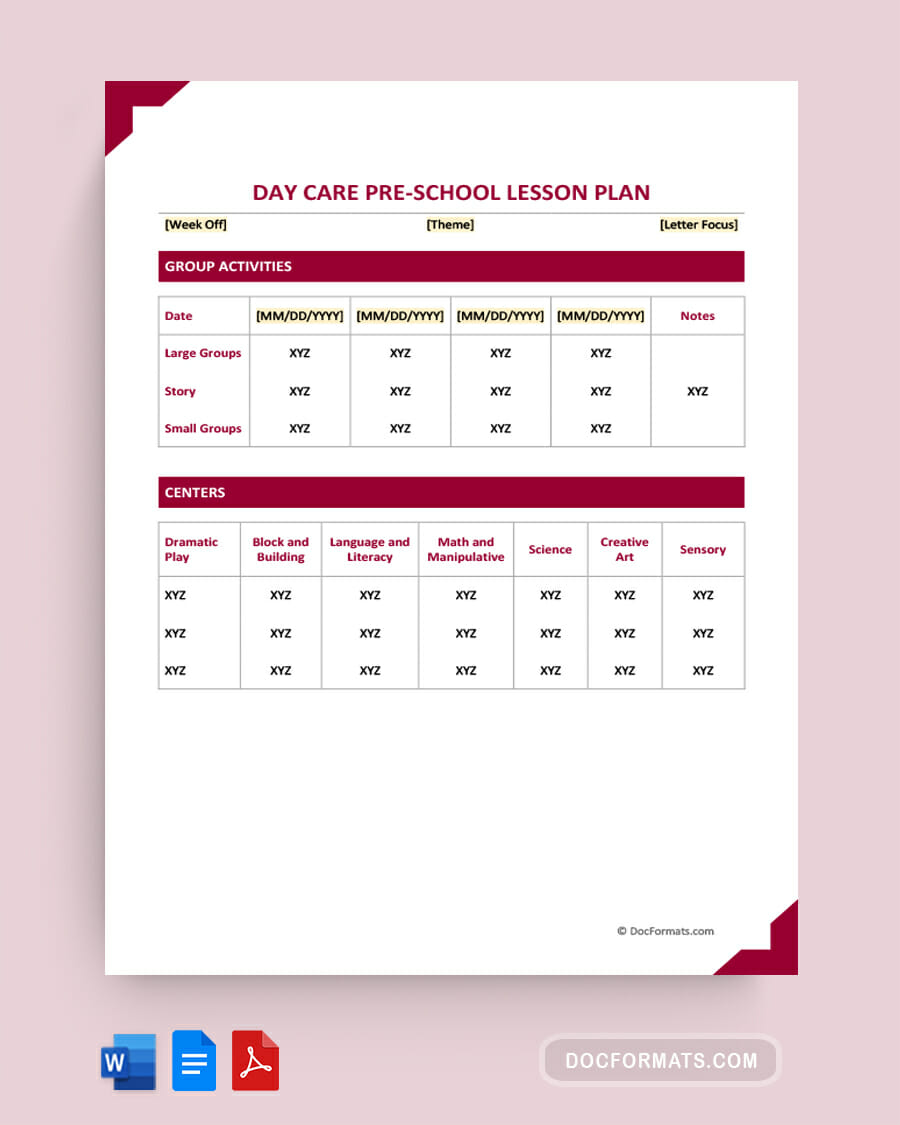


Importance of a Preschool Lesson Plan
Young children love to play. In an unstructured environment, random play will include some children and not others. Many will become bored and look for things to do that may not be constructive or positive.
Preschool teachers can build lesson plans that allow time for play and/or incorporate learning activities during structured play in the classroom. A lesson plan forces the teacher to consider the class as a whole and the developmental stage of the students and create challenging and fun activities that cater to the child’s development needs.
Walking into a class without a lesson plan can harm the students and frustrate the teacher. Students become bored, inattentive, and in some cases, out of control. The teacher appears unprofessional or incompetent to the parents, their peers, administrative staff, and even the students. Young children love interesting things to do, to be challenged, and to learn while enjoying their time at preschool.
Preschool lesson plans are never static. Teachers are continuously learning from each other, the students, and the parents through feedback. Once a lesson plan has been developed and utilized in class, it is important to reflect on the experience of the teacher and the students. There may be improvements and changes that can be added to enhance the lesson plan the next time it is used.
Preschool lesson plans are important for many reasons:
- The teacher is prepared for events in the coming days and weeks
- Challenging goals can be set for the students
- Provides opportunities to observe the students and update plans for the coming days
- Class progress and student progress can be compared to the lesson plan
- Lesson plans significantly assist substitute teachers
- Lesson plans can be communicated with the parents
- Guides support staff who are assisting the teacher
- Provides clear goals and objectives
- Improves the quality of the lessons
- Improves children’s ability to learn
Advantages of Using a Preschool Lesson Planning
Professional educators aim to be successful at their jobs; they receive positive feedback from students, parents, and senior staff when a class does well and exceeds school objectives and goals. Developing preschool lesson plans helps many teachers achieve these goals and makes them feel proud of what they have achieved with the children’s progress.
Lesson planning helps the teacher or caregiver to nurture the child’s cognitive development and social and emotional skills and improve their physical abilities.
Appropriate lesson plans can foster creativity during activities that also involve play and challenging, structured playtime. Hands-on, child-led, and exploratory activities help develop the creative side of the child while completing fun tasks and during structured play.
Being organized is paramount to a successful day in the classroom, especially with preschoolers. Materials and supplies are organized, additional resources are coordinated, and there is much less delay in setting up the day’s activities if preschool lesson plans are available to be followed.
They contribute to the effective use of the teacher’s time and the students during classroom activities.
How to Write Preschool Lesson Plans
Preparing a preschool lesson plan can use a template or follow the plan that may be adapted from a previous plan developed by yourself or another teacher. There are several steps to follow that will make preparation easier and that focus on objectives for the lessons you will be leading with the children under your care.
The following are the important steps in sequence to follow:
- Identify the purpose of your lesson plan
- Focus on keeping the activities simple
- Take student interests into account
- Decide on the approach
- Create your preschool lesson plan
- Identify the purpose of your lesson plan – what skills are being targeted? What is the scope of the plan, and what is the specific purpose? Social and emotional skills can often be developed and practiced through structured play bringing significant value to preschool-age children.
- Focus on keeping the activities simple – keep it simple, activities that are easy to describe and write down, and understand by you and/or others who may review your plans. Often the simplest, straightforward play with learning centers or circle time play can have the largest impact.
- Take student interests into account – children learn quickly when they are interested and involved. Choose activities that are interesting to the children while focusing on the learning activities and objectives for your lesson plan. Bored children will not pay attention and will miss the ideas and learning concepts in your preschool plan.
- Decide on the approach – will you lead the activity, allow the children to lead, play-based or skills-based, or a mixture of all of these during the activity? Select the approach that is appropriate for your children’s age and progression.
- Create your preschool lesson plan – based on the previous sections, write down your plan with as much detail as needed to help you and/or your assistants to lead the activity. A written plan can be referred to over and over again as needed.
Early Childhood Lesson Plan Template
The lesson for early childhood is indeed crucial, as it sets the foundation for a child’s future learning and development. The time period during early childhood is a critical stage, and it requires a well-structured format that allows children to engage in a balanced range of activities, including play, rest, nutrition, and learning.
A well-designed early childhood lesson plan provides opportunities for children to actively participate in play-based learning experiences. Play is a natural and essential activity for young children, as it promotes their cognitive, social, emotional, and physical development. It encourages curiosity, creativity, problem-solving, and social interaction.
In addition to play, it is important to provide designated time for rest, meals, and sleep. Meeting these basic needs supports children’s overall well-being and ensures they are physically and mentally prepared to engage in learning activities. When children are well-rested and nourished, they are more receptive to learning and are better able to focus and comprehend new information.
The structure of the lesson plan should be carefully controlled and age-appropriate. It should consider the individual needs and abilities of each child, as well as provide a supportive and nurturing environment. This helps prevent any negative impact on their psychological development and ensures they have a solid foundation for future learning.

Kindergarten serves as the first formal educational experience for children, introducing them to the learning system. Given that it is their initial exposure to school, it is crucial to develop a lesson plan that caters specifically to their needs and supports their orientation and ongoing learning.
An effective kindergarten lesson plan allows ample time for various activities that promote their development. This includes designated time for reading, playing, eating, and resting. Singing and playing activities are particularly important at this stage, as they provide an engaging and interactive way to teach and reinforce concepts.
Since most kindergarteners are still in the early stages of literacy, it is not expected for them to know how to write or even recognize their own names. Therefore, an active and hands-on lesson plan is essential. It should focus on experiential learning, incorporating games, storytelling, and sensory activities that stimulate their cognitive and motor skills.
Additionally, the lesson plan should prioritize social and emotional learning, fostering a positive and inclusive classroom environment. Collaborative activities, group discussions, and creative projects can help kindergarteners develop their social skills, build friendships, and develop self-confidence.
Pre Kindergarten Lesson Plan Template

Preschool Weekly Lesson Plan
As children progress through different levels in preschool, the educational experience becomes more structured and focused. It becomes easier to allocate specific time slots for various activities such as writing, reading, playing, and engaging in social activities within the school setting. By utilizing a weekly time-frame, educators can observe and track each child’s progress, noting their individual abilities and strengths in different areas. This information allows for the organization of a well-rounded lesson plan that caters to the needs and development of the entire class. By understanding each child’s capabilities and areas for improvement, educators can tailor their teaching strategies, provide appropriate challenges, and ensure that each student receives the necessary support to thrive. The use of a weekly schedule in preschool facilitates effective assessment, individualized instruction, and the creation of a comprehensive learning environment.

Weekly Preschool Schedule Template
A weekly schedule template is a valuable tool that outlines specific activities to be carried out at allocated times throughout the week. By utilizing such a template, educators can effectively track and manage their lesson plans. This structured approach provides several benefits. Firstly, it allows for a retrospective evaluation of the previous week’s activities, enabling educators to assess what has been accomplished and identify areas for improvement. Secondly, it helps in planning for future weeks by setting clear targets and objectives. By having a visual representation of the week’s activities, educators can better organize their time, allocate resources appropriately, and ensure a comprehensive coverage of the curriculum. Ultimately, a well-designed weekly schedule template facilitates effective lesson planning, promotes progress monitoring, and supports continuous improvement in the teaching and learning process.

Daily Preschool Lesson Plan Template
A preschool lesson plan template may vary depending on whether it is used in a public school or a private school. The format chosen can have a significant impact on the learning experience by introducing variety and eliminating monotony. Implementing a well-designed daily plan helps in engaging and energizing the children, ensuring a more dynamic and interactive learning environment. With an exciting template in place, it becomes easier to foster a positive relationship between the students, the school, and the teacher, promoting a friendly and welcoming atmosphere.

Blank Lesson Plan Template For Pre-K
This is an innovative approach to lesson planning that advocates for adaptability and flexibility on the part of the teacher. The plan allows the teacher to engage in freelance teaching, tailoring their methods and approaches based on the specific needs and circumstances of the students. This approach is particularly beneficial as it helps the teacher identify the most effective format to engage new pupils in the learning system. By fostering a collaborative environment, where students learn from each other, knowledge acquisition becomes a gradual but steady process.

FAQs
The following are several frequently asked questions many of our readers are interested in:
Lesson plans for preschoolers vary depending on the age of the children, the objectives of the school, and the period covered. A yearly lesson plan will cover broad areas of learning, while a daily lesson plan will be much more specific. Teachers may prefer to focus on plans for the next month, with breakdowns of weekly and daily plans to help them organize, ensure materials are available and assist students with overall learning.
The basic components of a weekly or daily lesson plan may include the following:
ᐅ Lesson description
ᐅ Objectives
ᐅ Priorities
ᐅ Activities
ᐅ Schedule
ᐅ Notes
Components for a specific subject, for example, math or English, might include the following components:
ᐅ Date
ᐅ Unit
ᐅ Topic
ᐅ Lesson starter
ᐅ Activities
ᐅ Standards addressed
ᐅ Additional notes
ᐅ Wrapping up
Weekly learning plans for preschool can be broader; however, they communicate the objectives, topics, and activities to be achieved for the week. Individual preschool lesson plans are developed for each topic:
ᐅ Monday – topics, activities
ᐅ Tuesday – topics, activities
ᐅ Wednesday – topics, activities
ᐅ Thursday – topics, activities
ᐅ Friday – topics, activities
A good preschool lesson plan has all of the components to help the teacher execute a successful lesson that helps the students learn and make effective use of the teacher and students’ time. A good lesson plan should always incorporate the following elements:
ᐅ Objectives
ᐅ Needs of the students
ᐅ Resources required
ᐅ Processes to be followed
ᐅ Evaluation methods
ᐅ Review and improvement methods
There is no right or wrong answer for how long a preschool lesson plan should be. However, a short lesson plan, lacking in details and void of objectives, resources, and activities, may be insufficient to meet the goals and objectives of the school, the teacher, and the students. Plans without details can contribute to ineffective use of everyone’s time.
Overly detailed plans are difficult to follow in practice, requiring a great deal of time to prepare, refer to and use.
A preschool lesson plan should be tailored to the time frame, i.e., year, month, week, or day, with sufficient information that a knowledgeable substitute teacher can utilize and effectively complete the days, weeks, or months activities with the students.
Keypoints
Creating and using preschool lesson plans utilizing templates not only saves preschool teachers time during the lesson plan preparation phase but also helps teachers deliver comprehensive, effective learning to the children they are teaching.
A preschool lesson plan template can be used as a guide to help prepare teaching plans for the entire year. Yearly plans and monthly and weekly plans will be less detailed than daily plans. However, they describe a roadmap for preschool lessons for the teacher to follow as well as substitute teachers if needed.
Parents and children appreciate a structured program rather than free, unstructured play. Children learn best when the educational elements are mixed with playtime and fun activities. Learning to get along with others, sharing as well as motor skills, creativity, etc. are significant benefits of an effective preschool learning plan.
With proper lesson plans, teachers can also ensure they have the appropriate resources available along with the materials they need for every lesson. Whether it is gym time, art materials, or visiting musical or yoga teachers, all of the resources are available when needed.


