
Jury duty is an essential civic responsibility that upholds the foundation of the judicial system. However, there are instances when personal circumstances may make serving on a jury challenging or impossible. In such cases, drafting a clear and concise jury duty excuse letter is a necessary step. It is important to note that these requests are subject to strict scrutiny, and the reasons must be legitimate and fall within the guidelines established by the law, which can differ from state to state. This article aims to provide you jury duty excuse letter examples, templates, and guide you through the process of writing an effective excuse letter while ensuring you understand the regulations that apply to your jurisdiction.
Jury Duty Excuse Letters
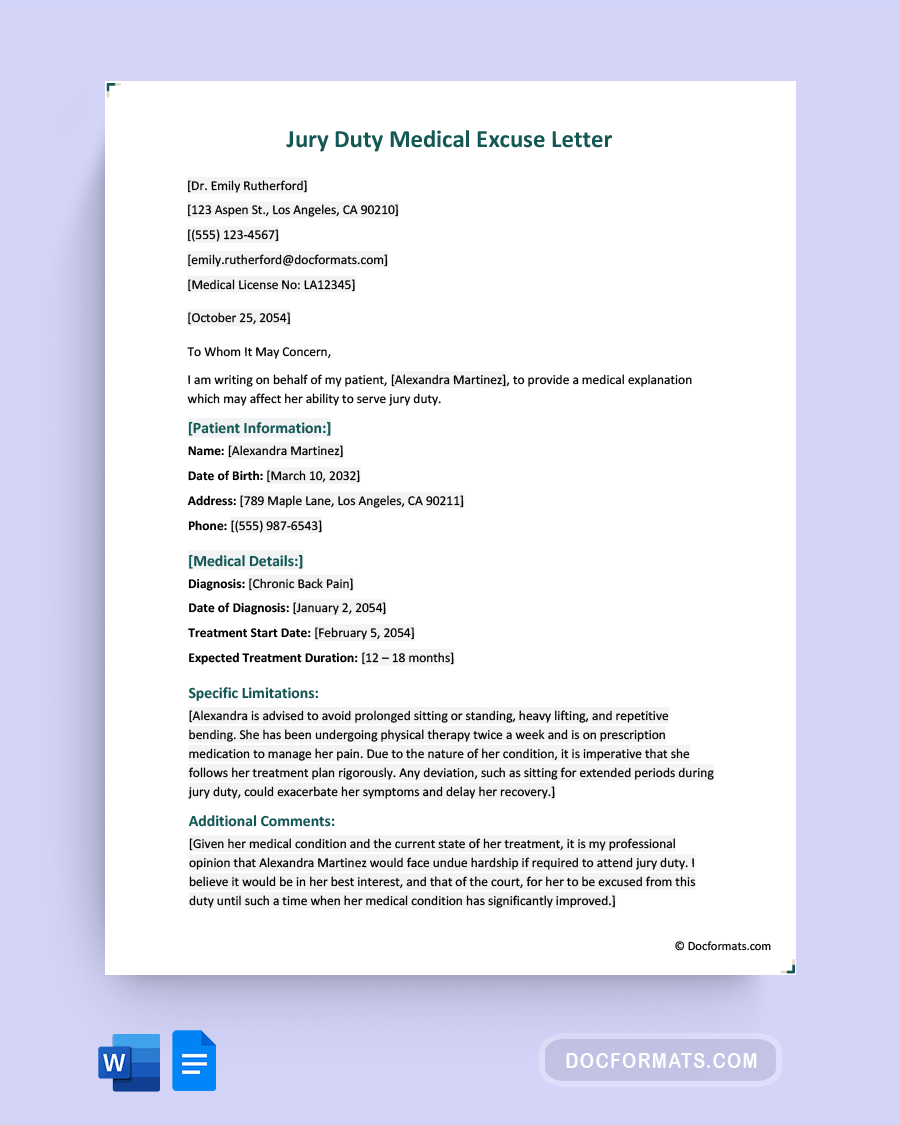
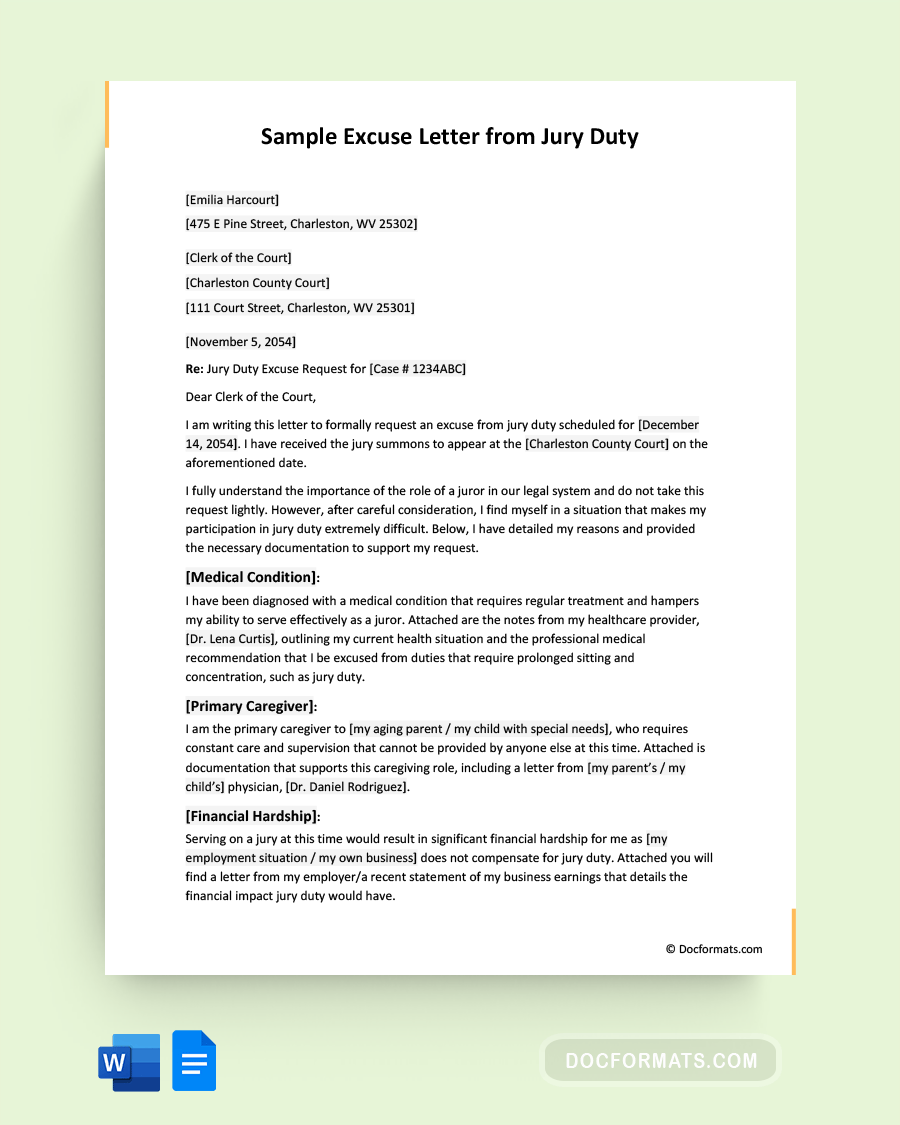
Crafting an effective jury duty excuse letter can be daunting if you’re unsure where to start. To help you with this task, we’ve included samples in both MS Word, Google Docs and PDF formats. These templates and examples will offer you a framework to model your letter, ensuring you cover all the necessary points in an appropriate format.




More Templates and Examples


Jury Duty Excuse Letter Template
[Your Full Name]
[Your Address]
[City, State, Zip Code]
[Your Email Address]
[Your Phone Number]
[Date]
[Recipient’s Name]
[Recipient’s Title]
[Organization’s Name]
[Organization’s Address]
[City, State, Zip Code]
Dear [Recipient’s Name],
Subject: Request for Postponement of Jury Service
I am writing in response to the summons I received to serve as a juror in the case of _ (specify the case), scheduled for (mm/dd/yyyy). It is with deep regret that I must request an exemption or deferral from this duty at the proposed time due to academic obligations.
Currently, I am a student at _ (specify college), in the final stages of completing my thesis defense. As such, I am deeply committed to academic tasks that require my full attention and presence. On the specified date of the jury service, I will be engaged in final presentations related to my academic work, which is an indispensable part of my educational journey.
I fully understand the importance of the civic responsibility of jury duty and I am more than willing to fulfill this duty at a later date, when my academic commitments have concluded. The postponement of my service would allow me to participate fully and with undivided attention in a future case.
For any immediate concerns or to discuss an alternative date for service, I can be reached at XXX-XXX-XXXX. I apologize for any inconvenience this may cause, and I appreciate your understanding and flexibility in this matter.
Thank you for considering my request.
Yours sincerely,
[Your Signature (for a hard copy letter)]
[Your Full Name]
Sample Jury Duty Excuse Letter
Saturday, May 16, 2028
Mr. Bruce Wayne
3657 Fourth Avenue
Suite 209
Fort Lauderdale, Florida
Dear Mr. Jackson,
Thank you for considering me for the role of a juror in the pending case, Jeremy vs. The State of Florida. I comprehend that the dispute focuses on the right of gay and lesbian couples to rent Christian guesthouses.
Despite understanding the gravity of the matter, I must regretfully decline your invitation. My personal beliefs, based on my interpretation of biblical teachings regarding marriage, may hinder my ability to serve impartially in this case.
As a juror, I am aware that my duty is to deliberate without prejudice. In light of my conviction, I fear that I may not be able to fully meet that requirement. Therefore, I kindly request that you consider an alternative individual who can effectively contribute to the jury.
Please do not hesitate to reach out to me at 866-693-6748 should you require further clarification or need to discuss any pressing matters.
Sincerely,
[Signature for hard copy]
Mr. Bruce Wayne Curator – Miami Dade Museum
How to get out of Jury Duty?
Jury duties are largely mandatory and attract hefty penalties if skipped or absconded. Nonetheless, there are some legal loopholes via which these duties may be skipped. Below are but a few of them explained:
- Claim Economic Hardships – You may claim that you might undergo some economic hardships if you choose to skip your duty and instead sit at the jury. If you choose this path, you have to provide convincing proofs and explanations as the taxman will usually follow the allegations up.
- Request for a change of Date – Next, you may agree to attend the jury, yes, but a late other than the one specified or requested. Of course, the courts will seek your replacement as they can never easily defer the hearings.
- Prioritize Trials that occur in December – Studies have shown that the trials that are held in December are more likely to be postponed than those held at other times. You should hence prioritize attending those trials as there is a strong possibility you won’t attend.
- Shift the date forwards rather than backward – Other than merely altering the dates, you may ask the court to shift the date forwards rather than backward. Chances are high that you will be placed at the bottom of the list and you won’t attend the hearings altogether.
- Invoke your student status – If you are a student, do not hesitate to invoke your student status. You will likewise be placed at the back of the list. Chances yet again are high that you won’t attend the hearings altogether. Moreover, it is easier for you to skip the hearings citing class attendance.
- Carry out further research – There are innumerable other ways and means of legally skipping jury duty. It is upon you now to conduct further research to find these ways and incorporate them into your tactics for missing hearings.
Understanding the Purpose of a Jury Duty Excuse Letter
A jury duty excuse letter is a formal communication addressed to the court requesting release from serving as a juror. There are several recognized reasons for such a request:
- Personal Hardship: Serving on a jury may impose significant personal inconvenience or hardship. This can include severe financial strain due to loss of income, inability to secure childcare, or the presence of a dependent requiring care.
- Medical Reasons: Health concerns are among the most common and compelling reasons for a jury duty exemption. A doctor’s note verifying a medical condition that prevents you from serving or could be exacerbated by service is typically required.
- Prior Commitments: Pre-existing, non-reschedulable commitments such as important business travel, pre-paid vacations, or educational obligations may be grounds for excusal.
- Civic Exemptions: Certain roles within the community may exempt individuals from jury duty, such as active military service, law enforcement, or emergency responders, depending on jurisdiction.
- Legal Disqualifications: There may be legal reasons for disqualification, such as not meeting the citizenship requirements, not understanding the English language sufficiently, or having been convicted of certain crimes.
What are a few good excuses to get out of jury duty?
Being excused from jury duty is a matter that courts take seriously, and there must be substantial reasons for such a request. Here are some legitimate excuses that courts may accept for deferring or excusing an individual from jury service:
- Medical Issues: A doctor’s note confirming that you have a medical condition that prevents you from serving is often a sufficient excuse. This may include scheduled medical treatments or ongoing health problems that would make serving on a jury difficult.
- Financial Hardship: If serving on a jury would impose a significant financial burden, such as a potential loss of income that is not recoverable, this can be a valid reason for exemption. Documentation or proof may be required to substantiate the claim.
- Prior Jury Service: Depending on the jurisdiction, having served on a jury recently may exempt you from serving again for a certain period.
- Conflicts of Interest: If you have a personal connection to the case or anyone involved in it, this could be a conflict of interest that would excuse you from serving on that particular jury.
- Bias: Courts require jurors to be impartial. If you have strong feelings about a case or subject matter that would prevent you from being objective, you may be excused. This must be a demonstrable bias that goes beyond general opinions or beliefs.
- Insufficient Knowledge: In some cases, if the subject matter of the trial is highly technical and a juror lacks the necessary knowledge to understand the issues at hand, they may be excused. However, this is less common as juries are often seen as a cross-section of the community, not experts.
Important: It is crucial to be honest and upfront about your circumstances when requesting an exemption from jury duty. The court typically requires evidence or documentation to support your claim. Furthermore, attempting to fabricate or exaggerate a reason for exemption can have legal repercussions.
How can I avoid being picked for jury duty?
While every citizen has an obligation to serve on a jury when summoned, there are certain conditions under which you may be legitimately excused. It’s important to approach this matter honestly and provide accurate information to the court. Here are some circumstances where the court may find an individual unsuitable for jury duty:
- Legal Incompetence: If you genuinely do not understand legal proceedings due to cognitive impairments or language barriers, you may be excused. This typically requires official documentation or a clear demonstration of the inability to follow the proceedings.
- Significant Pre-Existing Commitments: If you have non-negotiable obligations, such as a pre-booked and paid-for event or an important personal commitment, you may be excused. Courts often require proof of such commitments.
- Close Relation to Involved Parties: If you are closely related to any party in the case, you would likely be excused due to potential bias.
- Concerns About Impartiality: If you believe that your feelings on a particular issue relevant to the case would prevent you from being impartial, it is your duty to disclose this during the jury selection process.
- Active Involvement in a Criminal Case: If you are currently involved in a criminal case, this may be grounds for disqualification from jury duty.
Tips for writing a Jury Duty Excuse Letter
Composing a letter to request an exemption from jury duty requires careful attention to detail and adherence to specific guidelines. Below are tips to help ensure your letter is effective and compliant:
- Understand the Summons: Before you begin, it’s crucial to thoroughly read the summons. This document contains specific instructions and requirements for requesting an exemption, which can vary by jurisdiction. Understanding these will inform the content and format of your letter.
- Familiarize Yourself with Exemption Criteria: Know the acceptable reasons for exemption listed in the summons or by the court. An exemption request should only be made if you meet the specified criteria. Making a request outside of these reasons is not advisable and unlikely to be granted.
- Use an Appropriate Template: If you are uncertain about how to structure your letter, a template can be a valuable tool. Make sure to use one that aligns with your court’s requirements and that it is appropriate for your specific situation.
- Choose the Correct Format: Your letter should be formatted professionally, following standard business letter guidelines. This means using a clear and readable font, aligning all text to the left, and using proper spacing.
- Provide Contact Information: Include your full contact details—address, phone number, and email address—to allow the court to reach you with ease. This also facilitates any necessary verification processes or follow-up communication.
- Be Concise and Clear: Keep your letter straightforward and to the point. Clearly state your reason for requesting an exemption and provide any necessary supporting information or documentation.
- Proofread and Edit: Before sending your letter, proofread it for errors and ensure that it’s clear and concise. A well-written letter reflects your credibility and helps in conveying your message effectively.
- Adhere to Deadlines: Submit your exemption letter in a timely manner. Pay attention to any deadlines provided in the summons to avoid automatic disqualification from the exemption process.
FAQs
The summons you received will typically outline how to submit your excuse letter. This could be via mail, email, or an online system. Follow the instructions provided precisely.
Yes, in many cases, you need to provide evidence such as a doctor’s note for medical excuses, proof of travel for pre-planned vacations, or documentation of financial hardship.
The response time can vary. Some courts may provide an immediate acknowledgment, while others could take several weeks. Check with your local court for their specific timelines.
If you’ve submitted an excuse letter and haven’t received a response, you should follow up with the court. Failure to appear for jury duty without an accepted excuse can result in penalties.
Students can often be excused from jury duty, especially if they are attending school far from the court or have crucial academic obligations. Proof of enrollment and a schedule of classes or exams is usually required.
Conclusion
Addressing legal responsibilities with care and attention is paramount, and drafting a well-considered jury duty excuse letter is no exception. It’s an undertaking that demands thoughtfulness, particularly in light of the sensitive nature of judicial proceedings. By absorbing the guidance we’ve shared, you’re now positioned to approach this task with the requisite seriousness and precision.
Don’t hesitate to put this knowledge into action. With the insights you’ve gained, you’re ready to compose a letter that is both courteous and compelling. Begin drafting your excuse letter, confident that you have a thorough understanding of the process, and remember to tailor it to your specific circumstances using the information we’ve outlined.

